Sunday, April 12, 2015

Chemisier B by Tonje Thorensen


This is another stash busting project. I had some black and white printed cotton and an inexplicable need to mix my French language lessons with my sewing. Hence, I give you "Chemisier B" by Tonje Thorensen or rather as she describes it "Chemisier à col rond et manches à revers". (Blouse with round collar and reversed sleeves)

Thoresen, Tonje, and Catherine Guidicelli. Couture Vintage. Paris: Hachette Pratique, 2013. Print.

This pattern book, as with all my French pattern books and magazines, assumes you know your way around the haberdashery store, the sewing room and your fitting skills. There are no lengthy explanations or hand holding with these patterns. They are guide lines only. Your success is up to you skill depth. Now, having said this, I did have very good success with this pattern book and I'd be willing to try again.

This is a simple cotton blouse with a self-facing button front. It has set in cap sleeves with a reversed cuff finish. The collar is banded with a simple rounded collar. The bodice is fitted with a shoulder dart and waistline tucks in the front and back. Sizes in this pattern book range from EU 36 to EU 44. All sizes are shown on the pattern sheet for each pattern piece so that grading between sizes would be very easy to do. I traced the EU 44 size just as the book drafted it, before doing a pattern pin fitting. I decided to go ahead with the 44 without changing the pattern.


There were two things that I had to very aware of with this pattern. The seam allowances had to be added to the pattern and they were not the same width everywhere. I had to toss out the 5/8'' everywhere rule and remember the different widths for different purposes system.  I can see getting very used to this and automatically knowing where to cut larger allowances for better fitting. The second smaller problem was that the front and back of the sleeves and cuffs were very, very similar in shape. Careful marking and careful organization will save mix ups in this area.

Here's the finished garment on me. This photo was taken between gusts of freezing rain. I was not a happy camper for most of the March in terms of the weather.


Garment Finish: The fabric was a printed cotton and I serge finished the seam allowances and hem edges. I also used an iron-on interfacing. The cotton pressed easily and gave the blouse a crisp finish. Grade: A-

Fit: Good fit and easy adjustment with the waistline tucks. Grade: A

Material Choice: Printed cotton is always a winner for ease of construction. Grade: A

Style and Wearability: I love the print, but I'm not so crazy about the sleeves. Grade: B

Overall: A-

Next time, I think I'll try the Blouse à col Cravate in a silk print.

Wednesday, April 8, 2015

Shopping Bags or Something from Nothing

Today's post is about this kind of sewing that must be done, rather that the sewing that we all wish we could be doing. It's about the utilitarian sewing that fills most of my sewing days. Although, I'd much rather be dreaming up a brand new cocktail dress, what really needs to be done is the mending, and the hemming, and the remaking of worn clothing and the making of utility shopping bags.

My shopping bags get used and abused and they wear out. I needed new ones before I began losing my weekly shopping in drips and drabs through holes that had become too big to mend. 

This is a stash project; a perfect excuse to use fabric that just wasn't right for the original purpose. I had some brown denim-like material, that didn't wash well and was too stiff to use as a winter skirt. That's the brown stuff. I also had miles of leftover bias-cut quilting cotton from a mistake I made in arithmetic when finishing a quilt. That's the green stuff. Finally I had a good handful of stitch witchery left over from my Ikea curtains that was the exact width of the bias tape. That stuff is unseen on these photos.


I measured up my old shopping bags before tossing them directly in the trash. I simply transferred these measurements plus a seam allowance to the brown fabric and cut on the straight lines. I first hemmed the top of the bag front and back as well as the piece that was cut for the sides and bottom.


Next I estimated the strap length as twice the bag height plus the handle length. I cut four of these for each bag. I then used my stitch-witchery to "glue" two of the straps together. I edge stitched each strap before attaching it the bag. This produced a strong, sturdy strap with not much stretch. I top-stitched each strap the the bag from and back


After the strap was in place, I sewed the continuous sides and bottom piece to the front and back. To make this as easy as possible I placed wrong sides together and sewed leaving the seam allowance showing to the right side. This gave me a finished interior to the shopping bag. Finally, I used some more bias tape to enclose the raw seam on the outside. This second stitching of the bias to this seam gave me a strong seam and a finished look to the bag, both inside and out.


So, two shopping bags and some more space in my stash. Is it time to go fabric shopping again?


Thursday, March 5, 2015

Blue Bell Sweater

A long, long time ago, one of my favorite blog writers posted this pattern for the Bluebell Sweater. You can see her sweater on the linked page. You can also see the date, June 2014, for her post, it's now March 2015. I've spent nearly 9 months birthing this baby.

Look at that! Who wouldn't want one of those in a heather lavender over a grey wool skirt? Am I right?

Yeah...so off to the yarn shop...the only one in town...where the younger generation is apparently discovering knitting....thus I have a chunky, fuzzy, neon nest of acrylic selections from which to choose, because we all know that knitting a scarf should take no longer than an episode of "Suburgatory".

Finding anything worthy of knitting narrows the selection down to one brand and finding enough skeins in a single dye lot narrows it to two colors. I will not be making the long sleeve version.

This is the color I chose, teal? peacock? blue? I'm not sure exactly how I'd describe it. It does seem to be a nice wool and the label says washable. Now on to the next problem...

Lovely lady Lucy is in England. English patterns and needles are different sizes than mine. In fact, half of my needles are US and the other half are Belgian and I've long ago forgotten which are which. This means that gauge testing is extremely important for me. Throw in the fact that we, well, I am taller, larger...okay... fatter than the typical 1940's lady and there's nearly a complete pattern rewrite in that somewhere.


 Let's just say, I used the directions as a guide line and went my own way. The pattern repeat is over 36 rows. Quite a bit of knitting and ripping went on before I had my sweater going well. I, like Lucy, experienced the lacy like quality of the pattern. The sweater needs a camisole under it. My wool had a lot of stretch to it and my sweater doesn't fit as tightly as Lucy's or the model on the pattern leaflet. This is probably a good thing for me.

 Here's the finished sweater on my dress form, "Judy", without a camisole. You can see the blousing around the waist and in the sleeves. The wool is so soft and stretchy, if I had tightened up the tension, I really believe the sweater would shrink with the first wearing.  I'll have to live with the new silhouette.
Here it is on me. It's pretty, just not trim and form fitting as I'd like and...No, I'm not reknitting this one again. Overall, considering the hurdles and my inexperience with knitting...I have a wearable sweater. Is it as trim and neat as the original photo? No, not by a long shot. Would I try it again? Yes, in a cotton, silk, or rami blend but only after I visited a well stocked, English yarn shop for some advice.

Friday, February 27, 2015

George W. Trippon

Sewing tutorials on YouTube are a dime a dozen. A few are very high quality, many are sadly lacking. Most fall into the beginner sewing category or they try to tackle too much in one video.

I wish more of George Trippon could be found in Vogue's vault. The film is dated in fashion and fabric, but the information is timeless and George is very entertaining.


Wednesday, February 11, 2015

The Cost of Your Clothes

Now that you have cleaned out your wardrobe, it's time again to look at your wardrobe with respect to cost. The total cost of your clothing can be quite surprising for many people. It really doesn't matter what income bracket you are in, most people who haven't thought carefully and constructively about their clothes are in for a surprise when it comes to cost.

For this exercise, you will need a piece of scrap paper along with a pen or pencil. Go into your closet and look at each item. Estimate in round figures what you spent for each item. For example, think $50 for these jeans, $10 for this tee shirt, those are $100 shoes, go slowly and carefully adding up items. For each $100 dollar, make a tick mark on your paper. Don't forget the underwear, the swimsuits, the off-season clothes, the coats in the front hall closet, make a guess at what each item costs. When you have finished, add up the tick marks. Surprising, yes? It doesn't matter if you have a $3000, $30,000 or $300,000 wardrobe, if you are unaware of the cost of your clothing in relationship to your economic means the total can be a rough shock.

Many people make arbitrary rules about their clothing. I will only buy designer clothes. I will wear nothing that I haven't made. I only buy from thrift stores. I never buy anything at full price. I always shop at Neiman-Marcus. I feel these rules are rigid excuses not to take conscious control over our clothing choices.  We are letting some one else decide what we a going to wear. The designer has his vision, the major department store's buyer has narrowed your choices. The thrift store find has been filtered through someone's closet and then through the store's manager. Even by choosing to wear only clothes that you have made, limits you to the patterns and fabric available in your area. Think about any "rules" you have about your clothing. Are they limiting you?

Finally, before you close your closet door, let's consider how you can get the most from your clothing dollar. It will not matter if you learn to sew or not. These thought exercises will serve anyone who must shop for clothing.

Cost vs. Wearing
Consider your cost per item versus the number of times that you wear the item. Your $75 dollar jeans are a bargain if you wear them twice a week. That's 72 cents a wearing if you only keep them one year. Jeans should last 2-5 years and that makes it 36 to 14 cents per wearing. The $75 holiday dress that you only wear once to the office Christmas party, doesn't seam like such a bargain any longer, even if it was marked down from $125.

Now, obviously, there are no hard and fast rules for this. Each person much balance their cost and lifestyle circumstances for themselves. Look over your closet, are there items you definitely should have spent less on? Note them down in a small book that you can slip into your purse. Conversely, are there items you spend more on? Note these also. Assign a range for the cost you are willing to pay. For example, I will pay $25-$75 for brand new jeans. But if they are at a consignment shop, my top price is $10-$12.

Cost vs. Quality
Consider your cost per item versus quality. Your basic white tee from a discount retailer will have a certain quality to the finish. I'll bet it isn't cut on the grain and after several washings the side seams have twisted and the length has shrunk. On the other hand, a good quality tee shirt will wash and wear hundreds of times and not look like you've slept in it. Does it still make sense to buy the $5 bargain or the more up market shirt?
Can you recognize the marks of quality for an item? Make some notes in your small book about what makes sense for you.

Cost vs. Longevity or Fad
Consider your cost per item versus it's fashion longevity. Ask yourself should I spend more on a classic navy blazer or a leopard print knit dress? A leather jacket or leather pants? Make a list of must have classic pieces for your wardrobe and lifestyle. This should be where you spend your most amount of thought when selecting these pieces. The classic pieces in my wardrobe are the little black dress, a tan trench coat, a white shirt, and fitted tee, a pencil skirt in tweed, jeans, a cotton shirt dress and a blazer. These items are always in my closet and these are the core items that I will spend a little more money on than other things.


Now that you've considered each of these three areas, you may wish to balance all three in terms of your closet. How? Let's consider the basic tan trench coat. It definitely has fashion longevity therefore you might wish to spend more on a higher quality item, but let's then consider the number of times you will wear it.

So you live in the desert....  Living in a dry arid climate would make my choice for this item to be only moderately priced or even, if I'm lucky, a consignment shop find. I would consider it only to be worn a half dozen times a year and it would feel unwise to spend huge amounts of money on a raincoat. I would, on the other hand, choose an inexpensive coat with very classic tailoring because I know it would be with me for many years.

So you live in London....Where else in the world is known for more rain, fog and changeable weather than London? I would also choose a classically tailored trench and  I would choose the very best raincoat I could afford, knowing I would wear it nearly every week of the year. This is a climate where in addition to my core tan trench coat, I would be open to a second coat of lesser quality and perhaps more fashion forward. This could be another color or a different cut. I would replace this coat more often than my classic trench.

Make some shopping notes about what you need in your wardrobe and what you want to spend for it. Note also the qualities that will be important to you for each piece. Do this exercise when you don't have any sort of "shopping bug" working against your decisions. You want to create a game plan for yourself to make the most of your clothing dollar no matter if you learn to sew or not.


Tuesday, February 3, 2015

Stash Busting Project Number 1 - Grey Print Blouse

 My wardrobe needs a few more casual blouses. Shirts and blouses that can be worn with pants or skirts without needing a jacket are indispensable to my lifestyle. I mix and match these items endlessly dressing up and down as the situations change.

Here's a stash piece that is going to become a long sleeved blouse. This is an impulse buy from a remnants bin. I fell in love with the print and knew that this store has high quality fabric mixed in with lots of lower priced yard goods. The fabric felt nice, tightly woven and very crisp. But was it really good quality? I needed to be sure as I have been disappointed many times by the lack of transparent labeling of yard goods in Europe. Luckily, I was able to find the manufacturer's name on other items in the store and by the look and feel of those items, I was willing to guess that this piece was good quality but was from last season. The price was certainly within my budget and if it didn't wash well, I could always make a couple of grocery sacks out of the fabric. I bought it and stashed it.

I made McCall's 2094, View A from this piece. McCall's 2094 is currently out of print on the McCall's website. I think I bought this pattern around 2009-2010.  I love this pattern. It's a simple blouse with four sleeve options. It has plenty of darting to help with fit and the collar is simple and well done. From cutting to finishing, the blouse took just a couple of days to sew. I've made versions of this pattern at least five times and I'm always pleased with the results.

Garment Finish: This crisp, firm cotton was easy to work with and pressed like a dream. I serged the seam finishes to keep the project moving along quickly.  Grade: A-
Fit: This pattern has always been a favorite. I did a small FBA for this blouse, but I probably should admit my weaknesses harder and do a bit more adjustment in this area. Grade B+
Material Choice: A good quality printed cotton. It was an easy choice and gave excellent results. A+
Style and Wearability: Classic shirt styling along with simple details make this a wardrobe staple. It's already been through the laundry bin twice this month. I wore it with jeans on Saturday and earlier this month it went to lunch with a pencil skirt and sweater. Grade: A+
Overall: A

The photos are another problem. I'm definitely not pleased with these. My excuses are that it's January in Belgium and there is no day light. There really are no excuses. I should invest as much time in the photos as I do with the sewing.  I hope that spring is coming soon.


Monday, January 26, 2015

Confessions - The Stash

I have an incredibly guilty secret, my sewing stash. It has grown to the point of needing an entire room in my house dedicated to its safe storage. Some of the stuff will never be downsized. I cannot see myself getting rid of my machines or my ironing board. But the rest, yeah, I've got problems.

I try to limit my stuff, but temptation gets a hold of me, in particular, my fabric stash. It's out of control.
There it is down there on the left. Three bins stuffed so full that I can't close them. It's even piled on top.

Many ladies would say, "Posh, that's nothing. I have shelves...rooms...a basement...full of fabric." Yes, that's true for many sewers but most of those ladies might be called quilters or crafters. That's a whole different line of fabric hoarding, which I will not touch for now. These are all fabrics bought for clothing. Each bin has at least a two dozen projects.

What makes this a hoard for me is that I'm intensely uncomfortable with its size and embarrassed about the shear number of unfinished projects. During one previous move, I counted as I unpacked, the number was over 90. The stash has grown larger since that time. I hang my head in shame for all the clothes sitting there in those bins and not hanging in my closet.

I started fabric hoarding when I first moved away from my favorite fabric store nearly 20 years ago. At that time, they ran a mail order business and a quarterly newsletter went out. I bought from that newsletter like crazy woman, never finishing all the projects before the next newsletter arrived. I was desperately afraid I'd end up moving somewhere that fabric didn't exist. It turned out that happened several times over. Each time I got to a decent fabric store, I over bought. I couldn't say no in the face of the next fabric drought. So here I am today, trapped in a cycle of bounty and famine. I hoard fabric.

So the New Year has arrived, I have vowed to bust part of this stash this year.  In my idealized mind, it should be less than three projects. I'll celebrate if I have one bin in December, but in reality if I go from three overflowing to two neatly organized bins I will have done well.

The next two projects are stash busters. I've chosen two pieces of cotton out of the bin and I'm hoping for two casual blouses.

Thursday, January 22, 2015

Iron Deficiency


An iron used to be a highly useful household tool.

My mother's iron was indestructible and it was the same model as my grandmother's iron. If it needed a new cord, the hardware store had what you needed. If it needed a new heating element, the small appliance repairman in town could order the part. The iron was stainless steel, inside and out. You could descale it with citric acid and you could clean the sole plate with an old pair of nylon pantyhose and some baking soda. It had steam, but not enough for sewing or cotton shirts. We always used a damp pressing cloth or "sprinkled and rolled the clothes" to augment its steam power, but it was heavy. Oh my, was it heavy and pointy too. That old iron required the arms of a linebacker to finish a basket of clothes and I certainly remember being reminded again and again to "get the point of the iron around the buttons". In fact, my mother's and grandmother's collection of pressing equipment was rather short, a well padded ironing board, a tailor's ham, a water spritzer, a press cloth and a Turkish towel went along with the iron and that was it. My ironing accessories extend far beyond that in a desperate effort to overcome modern iron deficiency.

I have a love hate relationship with my most important piece of sewing equipment. The list of improvements from silicone treated sole plates to "electronically controlled heating" sends me right over the edge. Today's irons have a long list of design flaws.

The lovey rounded nose point might satisfy the health and safety lads, but you can't iron anything that isn't flat and wide. Forget about delicately shaping a hat ribbon or pressing open a narrow seam. Cuff plackets are simply impossible to iron properly any longer. The first criteria for choosing a sewing iron is a sharp point. If you can find one that  is sharp enough to open a tin can, let me know.

The new irons have sleek, silky, silicone soles. Let me tell you a woman who is sleek, silky and silicone is high maintenance. An iron with the same characteristics is not only high maintenance but is limited in function. What is wrong with polished stainless steel? It is good enough for boat fittings on the high seas and it will be good for all of your household needs. I need an iron that can go from panty pressing to applying wax on skis and back again in one day.  A polished stainless steel sole plate is infinitely cleanable and durable. A sole plate that doubles as a mirror is always helpful in a pinch.

When the stainless steel sole plate disappeared, so did much of the iron's weight. An iron needs to have weight to do its job. Today's irons are miracles of plastic, lightweight for sure, but you can't shape coat wool, set jeans hems, or make grilled sandwiches with any of them. If you can find an iron that will got through drywall when thrown, let me know.

Heat, weight, steam and effort combine to shape cloth. If one is lost, something must make up for it. In general, we've lost weight with modern irons and most of them make up the difference with steam power, but only for a bit. The heating/cooling cycle wreaks havoc with the plastic housing and in a few months what I have in my hand is a gurgling, dripping piece of electronic jetsam attached to the 240V line of my house. Iron at your own risk. In the last 10 years, I've bought four irons. Previous to that, I owned two! I'm considering buying a "dry" iron the next time around just for self-preservation.

Finally, the automatic shut-off....where do I begin. I suppose I could blame this on the health and safety lads again, but it's really about our own habits. If you leave the room, the iron is unplugged, off the ironing board, and stored in the cupboard. The cat/child/husband will never knock it off the board and start a fire. The argument about saving electricity should be one for the consumer. All irons have a manual on/off switch, use it if it's important to you.

I have spent the blog post ranting about what it wrong with modern irons not having given any sort of positive guidance about choosing an iron for yourself. An iron is a personal tool for each sewer. The kind of iron you need will be shaped by what you ultimately love to sew. Someone who tailors wool might value steam and weight. A quilter might value heat and a pointed sole plate.

For your first serious sewing tool, your iron should have a clean, unscorched, and unscratched sole plate. It should have a wide range of heat settings and a reasonable ability to produce some steam. I prefer to use the heaviest iron I can get my hands on and I consider the weekly ironing as part of my household workout. Features such as automatic shut-off and cord length are up to you.

The ironing board is as important as the iron itself. Choose one that is adjustable in height and has a sturdy wide surface. A well padded cotton work top is also well worth the investment. Stay away from the shiny metallic ironing board covers. You will end up with scorched fabrics. Pay top dollar for the board and it will last a lifetime.

To do the daily ironing and begin your sewing tool collection, the following items are essential. A cotton or linen press cloth and a spray bottle will augment your iron's steam output. An inexpensive white tea towel will do just fine as a press cloth. A cotton Turkish hand towel can be folded, rolled and shaped for additional padding when ironing your clothes. If you finally decide to try sewing clothing seriously, the next thing to buy is a tailor's ham, but other more specialized pressing equipment can wait until you hone your own sewing interests.

Friday, January 16, 2015

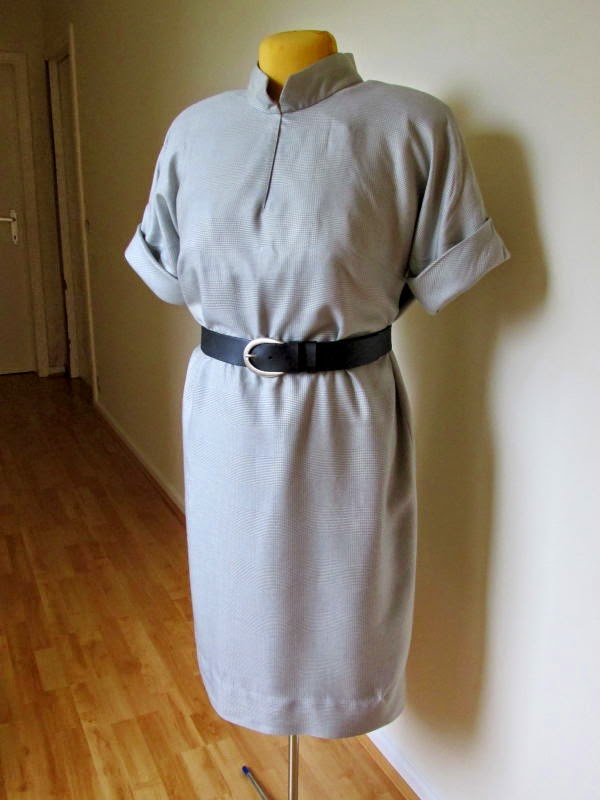
Vogue 7231 - 1952 The Slim Chemise Dress is Finished.

 The dress is finally finished. I'm not sure if I should cry in relief or anguish. It was baptism by fire for pattern drafting and I'm not entirely sure I succeeded. Here's the dress on a hanger. The previous top had problems with the neckline being to small and this final draft of the dress has the neckline to large. Somewhere there is a Goldilock's neckline, but I haven't found it yet.


Garment Finish: I made mistakes and plenty of them.
The choice of fabric is poor. It's a soft lightweight suiting in a glen plaid which doesn't show up in the photos at all. It's there. The suiting shows every stitch. Even after being careful the hem shows. The suiting is as a loose weave. This means the V-neck slash is prone to stretching and raveling. Therefore the neckline stretched as well as the center V. There maybe no amount of careful pressing that will save those hot messes. C-

Fit: The dress looks to be an absolute disaster, especially on the dress form and I would definitely pass the dress by if shopping by hanger. On me? It's okay. Surprising, it's better on me than the dress form, usually it's the other way around. B


Choice of Materials: It's a stash piece of fabric. I have long since forgotten where and when I purchased the piece, but I do know that it was bought during a time of my life when money was very tight. I'm quite sure it's a poly/cotton suiting. I like the color and the plaid, which you simply don't see in the photos.
I think dress would be best in a cotton or cotton/linen blend, something a little crisper and with a tighter weave. B-

Style and Wearablitiy: The dress certainly transfers to today's wardrobe. Modern fabrics and colors would work very well. The dress is comfortable to wear and very forgiving to those with fluctuating waistlines. I'm actually surprised at the fit. Given what it looked like in my sewing room on the dress form I had been very reluctant to finish the garment and declare the whole project to be a wadder. The same fabric tie belt helps create a unified silhouette. A-

Overall: B-
I might just try this one more time.

Tuesday, January 13, 2015

A Word About Laundry


Hopefully, you have completed your wardrobe clean out and are keeping up your idea sewing journal. Today's sewing lesson is a brief discussion about laundry.

"LAUNDRY?! I thought this series is about learning to sew. I KNOWWWW how to do laundry!"

Fair enough, maybe you do know all about laundry. But, if you answer yes to any of these questions, you need to revisit your laundry skills before investing time and money in making garments for yourself.

  • Do you only sort your clothes into three piles; whites, darks, and colors?
  • Have you wanted to wear something only to put it on and find it stained or wrinkled?
  • Do your white shirts and black pants all fade toward grey far too soon?

If you answer yes, then please consider revisiting your laundry guide that came with your machine.

After you know exactly what machine features you have, you need learn to read the laundry symbols on those garment tags. The website Textile Industry Affairs has a no nonsense complete guide to those symbols as well as answers to virtually every kind of laundry problem.

It is one of my personal reference sites for being comprehensive, although it does have a commercial tie with the Clorox bleach company. I tend to use chlorine bleach as a last resort and I prefer pre-treating and soaking before relying on any chlorine bleach. My front loading machine does not recommend using chlorine bleach because of the door gasket and my rural septic system prefers not to have bleach added to it.

Without too much detail, as everyone's laundry is a bit different and I could not, in any way, cover all the possible situations, these are my general laundry guide lines.

Sort by soil first.
Don't put your white athletic socks in the same pile as the white button down shirts.

Sort by color next.
Seriously, your red flannel pajamas should not be washed with your lime green tee-shirt.
Put similar colors together, reds and purples, greens, browns, and blues.

Sort by fabric and care labels.
You are wasting your clothing dollars if you wash  yoga pants with jeans.

All buttons should be open and all zippers should be closed.
Again, you are wasting your time and money, if closed buttons tear your shirts.
Open zippers catch and wear fabrics, especially jean fly zippers.

Use as warm a wash temperature as you can.
Warm water removes soil better than extra soap and bleach. Always cold water rinse.

Dry on lowest setting for the least time possible.
Dryers are tough on clothes. Line dry as often as you can.

If you don't have time to dry, hang and fold the wash as soon as it is done. Don't start it. It's all wasted effort if it molders in the machine. Better to load and soak the wash while you are busy than to wash and forget it.

...And that is all I have to say about laundry. Next up? Your first big sewing purchase!

Thursday, January 8, 2015

Vogue 7231 - 1952 The Slim Chemise Dress - Three more drafts later....


and I don't mean beers, although in retrospect it might have helped. I arrived at this interpretation of the Slim Chemise Dress. There was one glaring error that I didn't see until it was too late.


Here is the toile for the third draft. I thought, "Great! I've got it." Looking back, all I see is the error glaring at me front and center.


I chose some cotton print for this first attempt at a real garment. I decided on these two complementary leaf motif prints and I decided to make a blouse from this pattern rather than a full dress. The brown print will the main body of the shirt, while the green will be the cuffs and interfacings.


  I decided to add a little detail to the sleeves by putting four buttons and loops for each sleeve cuff. I wanted it to appear as if the cuffs buttoned on to the sleeve.

 I wanted it to appear as if the cuffs buttoned on to the sleeve.
The finished garment and its neckline error? The jewel neckline is too narrow and it pulls the front slash open. The shirt can never be worn with this pulled closed as seen on the Vogue pattern, but the shirt is wearable if only for Saturdays about the house.


The blouse modeled by the sewer.  My apologies for the grim face and poor lighting. I can't believe I made that mistake and winter in northern Europe only has so much daylight in any one week.

Old Cookbook Menus

These two days of menus come from a 1945 cookbook written by Vera Bradely. The book has an entire years worth of suggestions for three meals...