Showing posts with label VoNBBS. Show all posts

Thursday, June 9, 2016

The Slim Chemise Dress Again!


I've worn this several times since the last post. It's growing on me. It's extremely versatile and easy to wear.


Overall, I'll put this first complete pattern draft into the success column. I'm also will to go back to Vogue's New Book for Better Sewing and try another project. I'm thinking about Vogue 7101, the sheath dress.  Although, this one scares me a bit, because again, the poor girl hasn't eaten and I like to eat all too much. More lettuce, please!

Wednesday, May 25, 2016

Finally, I've nailed it!

I've had some time to get back to my copy of Vogue's New Book for Better Sewing. I've worn my two previous versions of the Slim Chemise Dress and tossed one of them out because the fabric was just not right for the project. Sometimes, only wearing an outfit for awhile will tell me what is wrong with it. I suppose this mostly falls from the fact that I sew for myself and by myself. I don't have another knowledgeable sewer nearby for fitting help, so fitting problems drag on for months in my studio. Enough about what ails me and let's move on to a minor accomplishment.

I am finally happy with my drafted version of Vogue 7231 - The Slim Chemise Dress. I finally understood the problem with the collar and pulled grain line of the front slashed opening. Below is a "photo" of the dress again in a navy blue linen. It is a comfortable dress that is easy to wear. It falls into the casual dress category and I am very pleased with the navy blue.

The grey plaid dress and the light blue linen dress have been pulled from the wardrobe. The grey became a wadder project and the light blue is in the "well...the yardage is good pile". This keeps the net gain to the closet in the negative territory.

Friday, January 16, 2015

Vogue 7231 - 1952 The Slim Chemise Dress is Finished.

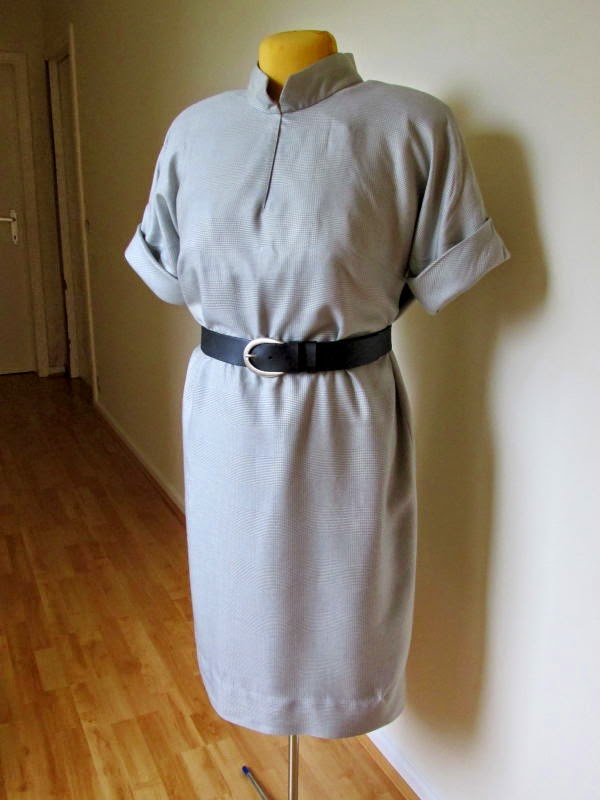
 The dress is finally finished. I'm not sure if I should cry in relief or anguish. It was baptism by fire for pattern drafting and I'm not entirely sure I succeeded. Here's the dress on a hanger. The previous top had problems with the neckline being to small and this final draft of the dress has the neckline to large. Somewhere there is a Goldilock's neckline, but I haven't found it yet.


Garment Finish: I made mistakes and plenty of them.
The choice of fabric is poor. It's a soft lightweight suiting in a glen plaid which doesn't show up in the photos at all. It's there. The suiting shows every stitch. Even after being careful the hem shows. The suiting is as a loose weave. This means the V-neck slash is prone to stretching and raveling. Therefore the neckline stretched as well as the center V. There maybe no amount of careful pressing that will save those hot messes. C-

Fit: The dress looks to be an absolute disaster, especially on the dress form and I would definitely pass the dress by if shopping by hanger. On me? It's okay. Surprising, it's better on me than the dress form, usually it's the other way around. B


Choice of Materials: It's a stash piece of fabric. I have long since forgotten where and when I purchased the piece, but I do know that it was bought during a time of my life when money was very tight. I'm quite sure it's a poly/cotton suiting. I like the color and the plaid, which you simply don't see in the photos.
I think dress would be best in a cotton or cotton/linen blend, something a little crisper and with a tighter weave. B-

Style and Wearablitiy: The dress certainly transfers to today's wardrobe. Modern fabrics and colors would work very well. The dress is comfortable to wear and very forgiving to those with fluctuating waistlines. I'm actually surprised at the fit. Given what it looked like in my sewing room on the dress form I had been very reluctant to finish the garment and declare the whole project to be a wadder. The same fabric tie belt helps create a unified silhouette. A-

Overall: B-
I might just try this one more time.

Thursday, January 8, 2015

Vogue 7231 - 1952 The Slim Chemise Dress - Three more drafts later....


and I don't mean beers, although in retrospect it might have helped. I arrived at this interpretation of the Slim Chemise Dress. There was one glaring error that I didn't see until it was too late.


Here is the toile for the third draft. I thought, "Great! I've got it." Looking back, all I see is the error glaring at me front and center.


I chose some cotton print for this first attempt at a real garment. I decided on these two complementary leaf motif prints and I decided to make a blouse from this pattern rather than a full dress. The brown print will the main body of the shirt, while the green will be the cuffs and interfacings.


  I decided to add a little detail to the sleeves by putting four buttons and loops for each sleeve cuff. I wanted it to appear as if the cuffs buttoned on to the sleeve.

 I wanted it to appear as if the cuffs buttoned on to the sleeve.
The finished garment and its neckline error? The jewel neckline is too narrow and it pulls the front slash open. The shirt can never be worn with this pulled closed as seen on the Vogue pattern, but the shirt is wearable if only for Saturdays about the house.


The blouse modeled by the sewer.  My apologies for the grim face and poor lighting. I can't believe I made that mistake and winter in northern Europe only has so much daylight in any one week.

Wednesday, January 7, 2015

The New Year and A Finished Slim Chemise Dress

Hallelujah! The Slim Chemise Dress, Vogue 7231 from Vogue's New Book for Better Sewing (1952) is finished. This is a first for me in that I started with only a photograph and a general drawing of the pattern pieces. Normally when I copy something, I have either the actual garment to copy or a good photo and a similar pattern from which I alter the pattern to give me the specific details. In this case, I did not have any pattern that was remotely similar.

I find drafting from scratch hard and time consuming. I know I would benefit greatly from a well-developed course on pattern drafting but time, location, and funding have put that off for the a while.

I am reasonably pleased with the results of the dress. It's a bright sunny morning today. I'm hoping photos will happen this afternoon.

Wednesday, December 3, 2014

Oh dear, oh dear, oh dear.....

I've fallen into a giant sewing hole and I'm battling my way out. Let's just say that drafting this pattern has become a nightmare. I should have made at least 2 more muslins, but nooooooo....I thought....3 is enough....I can do this.  HA! The karma in my sewing room has risen up from the threads on the floor and linted up my brain and taken more than a few pegs out of my sewing hubris.

"Needles" to say there have been tears and frustrations. I am battling on and I promise there will be a garment out of this yet. In the meantime, I'm keeping my eyes firmly on the pattern drawing and out of the overflowing waste basket in the corner of the sewing room.

Tuesday, November 18, 2014

Vogue 7321 - 1952 The Slim Chemise Dress

 I closed my eyes and jumped of the high diving board into pattern drafting with this project and I definitely feel like I'm drowning. Clearly, this is a detailed oriented skill that needs to be developed over time under the tutelage of an experienced drafter. After a lot of time, many stops and starts, and several rolls of paper, I got a bodice front and back.
 From there, it was another roll or two of paper and I think I have a first guess at my recreation of Vogue's 7321 Slim Chemise Dress from Vogue's New Book for Better Sewing.


Sooooo....I cut my first muslin. Not bad....but some issues exist. The collar is too high and the sleeves are not long enough to accommodate the cuffs turning back and finally the bust dart is not quite right.
Back to the drawing board!

Thursday, October 30, 2014

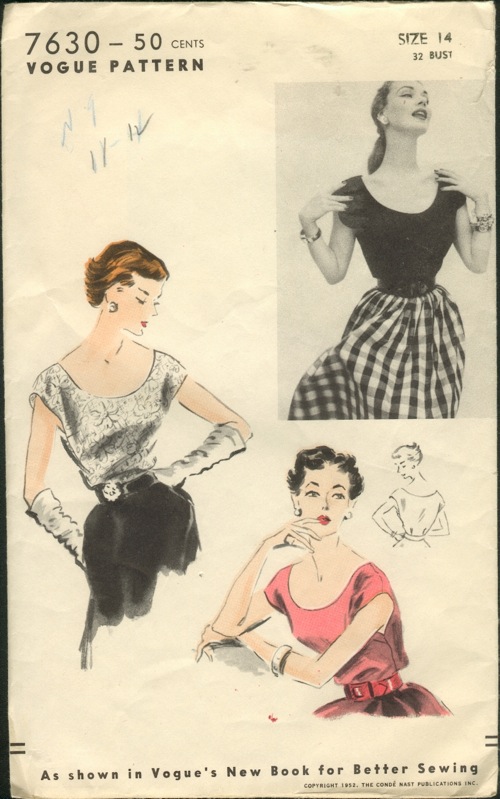
Vogue 7630-1952 - The Portrait Neckline Blouse - Finished


Pattern trial number two gave me this. Four pieces, that except for the full bust, looked pretty similar to the illustrations in VoNBBS. I specifically choose to create "net patterns", that is, patterns without seam allowances. I found this gives me an easier time doing a couple of things, fitting on my dress form and "walking" the seams. 

Then, I got busy with the project and didn't pick up my camera until nearly the end....hemming the sleeve.

Here's the finished blouse with the slim skirt and my farmer's tan.

Here it is again worn as an over-blouse with the gingham skirt. The black color and poor lighting of late autumn in northern Europe sucks all the detail out of the photo.

Garment Finish: Good to excellent overall. This is a linen blouse, so I chose to over lock the seam edges to prevent raveling. The zipper is a lapped application in the side seam.  A-

Fit: Actually, I'm surprised. My first attempt at pattern drafting isn't bad. The fit is good, maybe a little large, but I've certainly had far worse at the hands of other pattern makers. For a first project: A-

Choice of Materials: It's linen. It wrinkles! It's clearly a summer blouse. I would choose cotton next time for ease of washing, or silk for something dressy. B+

Style and Wearability: This 1952 style still works today. I could make this out of a number of different fabric or colors. As you can see I have paired it with the more formal slim skirt and the casual gingham skirt and I've got two distinct looks. I could wear this with jeans and a blazer also.  A+

Overall: A-
Not bad for jumping in at the deep end of pattern drafting.


Tuesday, October 28, 2014

Vogue 7630 - 1952 The Portrait Neckline Blouse

   
     According to VoNBBS, the portrait-neckline blouse is "easy-to-make" and "has a way of making you look your prettiest and most feminine." Well, bottle that up and sell it! I'm buying. It's a blouse, a simple one at that. There are no sleeves, cuffs, collars or buttons. What's not to like?

     Plenty, when you don't have a commercial pattern at you finger tips. This week, I cracked open the dreaded "Pattern-Making for Fashion Design" by Helen Joseph Armstrong. I felt as if I'd gone back to school...the tables, the diagrams....the exercises...the revelations!

     The second chapter is an exhaustive discussion of fashion industry standards, how they are categorized and why they may or may not be used. Next came a five or six page set of exhaustive diagrams on how to take all 38 plus measurements from a standard fashion industry dress form. Many of these, such as bust, waist and center front length are very familiar, but others such as abdominal arc, bust span and strap length were completely new to me.

       As I don't have a industry standard dress form hanging around the work room, I took my own measurements and filled out a two page form from the book's appendix.  I had it on paper, me in Oct 2014, every roll, ripple and bulge. Then, I turned the page and found a table entitled "Standard Measurement Chart". Across the top of the table ran the headings grade and size, from size 6 to 18 and down the size ran a list of all the measurements I had just painstakingly recorded for myself. For kicks, or a malicious sense of self-inflicted pain, I circled my real measurements as they appeared on the table.

      The results were both humiliating and revealing at the same time. All my "vertical" measurements fell into the 6-8 size and all my horizontal measurements fell into the 16-18 size. This explains so many of my fitting problems with commercial patterns and why I cannot find retail clothing that fits. It also scares the heck out of me for pattern drafting.

     I won't bore you with all the gritty details of Chapter 3 - Drafting the Basic Pattern Set, but I will say that my 6-8 by 16-18 figure created drafted drawings that in no way looked like the illustrations in the textbook. The result was a lot of self-doubt, many repeated exercises and several rolls of pattern paper and a couple yards of muslin on the work room floor. In the end, I did get a skirt and bodice basic block pattern completed and fitted. I have not attempted a sleeve block. That will come later, perhaps in the spring.

     Using the block as a guide and skipping through dart and neckline manipulations, using only those exercises that applied to Vogue 7630 - 1952, I came up with this trial pattern.


 ...and this first muslin.
Hmmm...trial two....coming up.


Friday, October 17, 2014

Simplicity 1590 - Forties Blouse


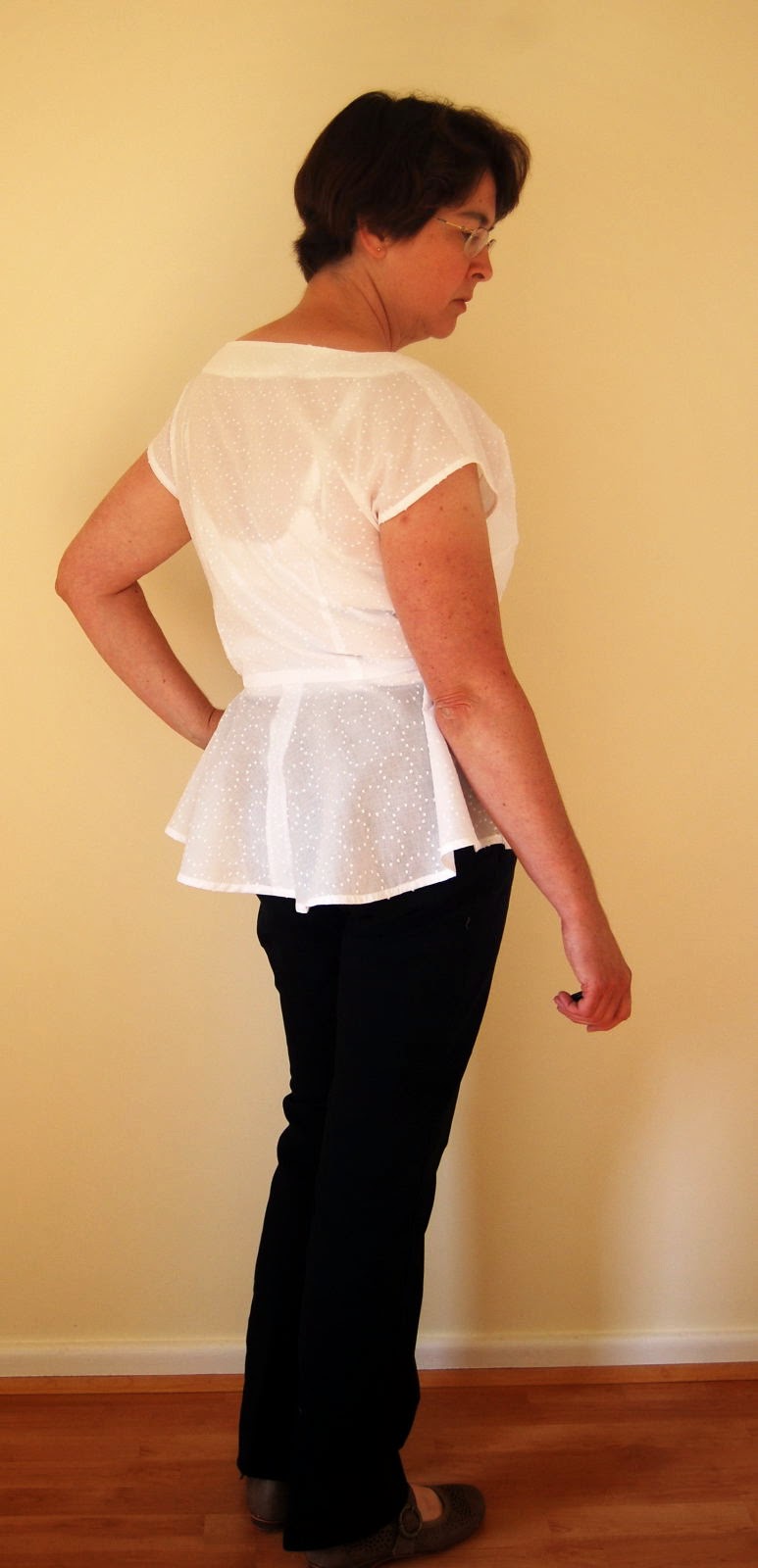
Well, it's finished. I'm not sure I like it. I think the choice of fabric is all wrong.

The cotton is just too transparent. I'm also wearing it in October; this is summer blouse that needs a light colored cotton skirt underneath it.

The garment finish is good. I didn't spend a great deal of time on special seam finishes with this garment. The quality of the fabric just didn't warrant the effort. This project is much more about style and pattern testing than french seams and organza interlining. Garment Finish: B-

Fit: The fit is good. The back and waist are smooth and there is no gaping in the front. The full bust adjustment is a success. Fit: A

Choice of Materials: C- It's not a complete failure, but nearly so. The cotton is shear but very inexpensive. It won't wear well in the end and therefore didn't require the extra time and expense of lining the blouse. Given that, I still wouldn't want to spend a great deal time or money for a first trial of a new pattern. I think this garment would look better in a silk, charmeuse, or nice dress weight cotton. I will be worth trying it again before deciding if the pattern is a keeper.

Style and Wearability: B  The blouse is very much a success in someways and a dismal failure in others. As this project is a precursor to the completely self-drafted copy of the VoNBBS's portrait neckline blouse, it is weighted more for a success. The neckline is attractive and flattering. The cap sleeves give just that little bit of cover for the shoulders. Both these features are important for VoNBBS's Vogue 7630.  I don't care for the peplum. It emphasizes a part of my body I wish to ignore and I cannot tuck this blouse into a skirt or pant. This limits it's wearablity.

Project Overall: B-

Now, I'm looking forward to my first redraft of an old pattern from VoNBBS, Vogue 7630, the portrait neckline blouse. I think I can do this! Think positively! I can do this.....yes, maybe, welll...let's see.

"Patternmaking for Fashion Design"  by Helen Joseph Armstrong here I come.

Wednesday, October 8, 2014

The Next VoNBBS Project - The Chemise Dress or the Portrait Neckline Blouse?

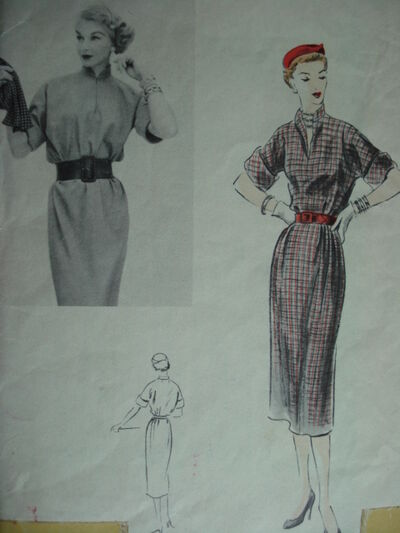
I've been thinking seriously about the next VoNBBS project. I've completed the two projects that are based on rectangular pattern pieces and now I must jump off the cliff into pattern making or rather pattern reproducing and adjusting because...well, look at our lovely Miss Vogue 7231, she hasn't eaten since 1951.

The two easiest patterns for beginning pattern drafting will be the Chemise Dress and the Portrait Neckline Blouse.

I'm very tempted to start here with Vogue 7231 because is looks so modern. We are still wearing this shape today. Here's a modern pattern for essentially the same look. Although, please Vogue be careful of your fabric choice and construction before using the sample as the pattern photo.

However, after looking at the general shape of the pattern pieces from the original pattern, I'm doubting myself.


For heavens sake, look at them. There's not much there. There is nothing to hang a T-square or triangle on. There are few discernible points to begin with ...center back and front and a slight indication of a front bust dart, but other than that the pattern lacks definition. I think this could be very easy to get very wrong very quickly, especially since the fabric in my stash is a plaid. I want to show off the bias cuffs but the rest of the dress had better match. Being off grain will not be acceptable on this project. I think a solid fabric might hide these fundamental  pattern errors and I wish to avoid them at all cost.


Vogue 7630 is the other choice, a little blouse. Its pattern shapes are far more recognizable when compared to my pattern drafting textbook. The neckline could be very tough to get right...until I remembered this post. See it there right in the middle, I have it! It's in my pattern stash ....a portrait neckline blouse... a retro portrait neckline blouse! This will be the way to go.

....Actually, anything to delay cracking open that textbook and evaluating myself next to fashion industry standards.

Tuesday, October 7, 2014

Vogue 7436 - 1952 Final Evaluation

The Slim Skirt from VoNBSS is finished. It's a straight skirt. This silhouette has become a wardrobe staple over the years. There are hundreds of pattern choices for the home sewer. There are shorter ones and tighter ones. There are patterns that are pegged at the bottom rather than straight. Pick one that suits you and sew!

For this project, I got a small taste of draping instead of pattern cutting and I found this rather freeing from the "rules and regulations"of the pattern direction sheet. I also found that I had to keep my wits about me and not finish some parts of the garment before others. There must be an order to the process.

The garment finish is rather good on this garment. I'm pleased. It is fully lined. The zipper in hand picked and the hem is well padded and invisible from the outside of the garment. All seams are finished. I'm not pleased with the waistband interfacing. Let's just say I don't have many choices here and it shows. Overall: A-

The waistband of this skirt is a little tight. I learned something about the interaction of ease and turn of the cloth with this project. Also, don't sew while the plumber is in the house! You will not try things on as needed and adjust when needed. The moral of the story is clean when there are people working on the house and sew when everyone is gone. Fit: B

Choice of Materials: A+    Actually, this couldn't have been better. The houndstooth is a classic weave. The black and white is timeless. The wool was forgiving and easy to work with. I couldn't be happier with the materials.

Style and Wearabilitiy: A-  The tight waistband limits the wearability a bit...but three pounds and that will go away. The style is as wearable today as it was in 1952. This should be wardrobe corner post for many years to come.

Overall: A-

Friday, October 3, 2014

Vogue 7436 - 1952 The Slim Skirt - Top and Bottom

 I can't bore you with endless construction details for this project. The reason is simple. I got involved in this project and didn't surface to breathe until I was nearly finished. I just didn't think about photos until it's too late. Here are a couple photos of the nearly finished skirt.


 Draping was the way to go for me on this project. I was able to adjust pleat and dart arrangements for my specific problems without feeling I was violating some unwritten rule about following a pattern religiously. I blame my 8th grade home economics teacher for this. I still don't mix my blueberry muffins without hearing that woman's withering comments. But that's another post on another blog, maybe with my analyst.

Above is the top of the skirt and the center back seam. I left it extra wide for "extra pounds, " later...let's hope not. The wool is finished with black bias tape and the zipper is set by hand with a prick stitch. The entire skirt is lined.

 Below is the bottom of the skirt or hem. I've interfaced the hemline with some muslin to pad out the the turn of the hem so I don't get a sharp crease. There is bias tape applied to the wool and the hem will be stitched in place by hand with a catch stitch. The lining is hemmed separately with a deep double fold hem for extra weight to prevent riding and bunching.

Wednesday, October 1, 2014

Vogue's New Book for Better Sewing - Vogue 7436 - A Slim Skirt

After completing the first VoNBBS project,  the Full Gathered Skirt, without much trouble in the pattern drafting department.  What I really mean is that I knew I couldn't get into much trouble with three rectangles. It's time to choose a project that isn't a complete rectangle...well almost. It's a rectangle with a kick pleat on the back seam.

The pencil skirt is a fashion icon that is still in our wardrobes today. I have several of them and I wear them constantly. Who's not to like another? ...especially one in houndstooth plaid, just like the photo...okay, okay... the photo plus 40 pounds.  I gathered up my materials and started to ponder the benefits of cutting another rectangular pattern. Then after overdosing on multiple old "Project Runway" YouTube clips, I ran away with myself and draped the silly thing.


Honestly, who needs patterns? We can imagine for one afternoon that we are something we are not; skilled at this. Here's the first look at the draped skirt.

Wednesday, September 24, 2014

Back to 1952 - Vogue 7375

Remember this skirt. It's from VoNBBS and my interpretation of pattern Vogue 7375, the full skirt. When I made this I had some serious reservations about the dirndl skirt silhoutte and my figure type. Although, the skirt was a successful sewing project, I personally believe that this style has limited appeal for me because of the amount of fullness in the gathers at the waist. It's successful only because of the lightweight gingham fabric. I really like full skirts but I wanted to be able to use a larger variety of fabrics, for example a poplin or mid-weight cotton.

So I put my thinking cap on and came up with one of my first "drafted from my head and personal sketch" garment. I want a full hemline and a plentiful skirt length. I needed to eliminate fullness at the waist and lengthen my torso length. Finally, the garment had to be easy enough so that a sewer, who like me relied for years on commercial patterns, would be confident enough to give it the old college try.

The answer was easier than I anticipated and here's preview of the some of the features of the finished garment.


Simple over-locked seam finishes on the crisp 100% cotton fabric.

A side seam zipper that goes all the way through the waistband thus eliminating the bulky lap and button.

 A narrow twin-needle machine stitched hem.

Fabric self faced waistband 


Next time...the finished garment!

Wednesday, July 16, 2014

Vogue 7375 - 1952 In Today's Wardrobe

After a couple of washings and wearings, my first 1952 Vogue 7375 skirt has settled down to be part of my modern wardrobe. The gathers at the waist have softened and flattened and I'm more pleased with the effect. I nearly always wear it with a simple tee shirt and a cotton cardigan sweater. Fundamentally, I'm still uncomfortable with the waist of this skirt as I couldn't make this garment again out of a crisper or heavier fabric. I'm going to think very carefully about how a full skirt can be made to fit my body type better than the dirndl silhouette.

Next project is a denim skirt. It's a more of work horse in my wardrobe than a pair of jeans and I need to replace it often. I've chosen a simple A-line skirt pattern and the denim came from my last fabric haul.

Tuesday, July 15, 2014

Vogue 7375 - 1952 Final Evaluation

Oh dear, life's major and minor events have taken me away from my sewing room and this blog for far too long. I have finished my first project from VoNBBS. This is my take on Vogue 7375 - The Full Gathered Skirt.
 Here's the finished skirt on my dressmaking form. I'm happy with the finish of the garment. There are no major mistakes, even after I had to adjust the waistline measurement and loose my couture buttonhole. The plaid matches very well. You can see the black stripe at the waist is about half waistband and half gathered skirt. The hem line is straight and ends with about 3/4 of a black stripe.

I am concerned with the gathered waist and my thickening middle. I've said this before on the blog,  I have three major fitting problems. They are a larger than average bust line, a thick waist and a short waist length. Only one I can do anything about physically, the thick waist is a constant battle that is proving more and more difficult as the years go on. The other flaws are just my body type. Normally, I wouldn't choose this type of pattern because it draws too much attention to my mid-section. Contruction grade: A-

And I was correct! Not the best look for me, but it's not a complete failure. (Yes, worse sewing disasters have been made in the recent past.) The light soft gingham saves the look by not be too puffy at the waist. I would wear this with an untucked blouse or sweater rather than the belt. Style and Wear Ability: C-

Here it is again with a black twinset sweater. I apologize for the photo. The quality is simply awful. It has a huge flash shadow which adds so much more width to the whole effect. The skirt style is much better with a sweater or over blouse, however the black twin set and pearls is a far too literal interpretation of the 1950's and the effect becomes costume. Style and Wear Ability: up one-half to a C.

I'm going to have to think seriously about the styles in VoNBBS and pick and choose very carefully.

Saturday, June 21, 2014

Vogue 7375 - 1952 Construction

The skirt is very straight forward to put together. All the seams are straight stitching. It will be the finishing details that make the garment. The back seam, which has the zipper closure at the top, I have pressed open and have finished the edges with a Hong Kong finish. This first photo is the bias strip applied to one side of the seam. 


 Here, I roll the bias around the edge of the seam allowance and finger press it open. I pin the bias in place and  I will stitch in the ditch to secure the bias to the back side of the seam allowance. Since it's bias cut no further finishing is needed and the gingham will not ravel.
 Next I basted the zipper in place, before machine stitching the zipper. I prefer to take this extra step. It allows me to make small adjustments and if I don't like the zipper placement. The hand basting is a flash to remove, not so when it is machine stitched. I also find that the pins just don't hold things securely enough.
 Hand basting helps me to achieve good results most of the time, especially when dealing with matching plaids. The other two skirt seams were done with quarter inch french seams. I don't have photos because I became so engrossed in my work that I forgot to take the pictures.
 I did make a bound button hole for this garment, butttttt.....I had to remove it because shortly after this garment was completed I went on a diet and succeeded. Two inches disappeared from my waistline and the fastest way to remove them from my skirt was to open the back waistband seam and adjust an inch on each side. Looking back on this, the bound button hole is a nice teaching point for VoNBBS, but I think the machine stitched buttonhole will hold up better particularly because waistbands can be a source of stretch and strain for many woman. (Note: Including me....especially including me.)Two lines of gathering stitches and many pins secured the waistband to the skirt body for basting.

For the hem. I used a satin ribbon hem tape and some careful hand stitches. My hem was slightly over three inches deep. I cut the skirt so that the hem line would fall on a black horizontal stripe and I rolled about a quarter of the stripe to the back in the hem. If I hemmed either on the exactly the line between the horizontal stripes or on a white stripe I felt any small lack of accuracy would be noticed. The black stripe seemed to minimize these errors.

Old Cookbook Menus

These two days of menus come from a 1945 cookbook written by Vera Bradely. The book has an entire years worth of suggestions for three meals...