I didn't think Mr. Grinch was quite finished removing the holiday decorations from the house.
With the help of the internet and Pinterest, along with a bit of foam core board, some poster paint, a Sharpie marker and an Exacto knife. I came up with this for the front door. The wreath, I had purchase many years ago, is a plastic "boxwood" wreath which will not scratch up the door. Mr. Grinch's hand is secured to the wreath with a couple of produce bag twist ties from the junk drawer.
Sunday, December 13, 2015
Friday, December 11, 2015
A Pause in the Sewing...for Christmas
December has come, dark, rainy, wet, miserable December. A month better designated for hibernation than celebration. Yet, in someone's ancient wisdom, the second most important holiday in all of Christendom is celebrated during the darkest, wettest, most miserable time of the year. I'm not a fan....that is to say I'm not a fan of Christmas in December.
I often wonder if I would have had a better attitude toward this holiday had I been born Australian. In some ways, summer BBQ's, beach parties and fireworks seem more in keeping with a joyous birthday occasion, rather than rain.... and ice...and snow.
But never fear, I was lucky enough to have been born just post Geisel Seuss and my childhood was filled with such characters and Horton, Yertel, and the Lorax, but most beloved of all was the Grinch, a man after my own heart. Ultimately, the Grinch does come to understand the true meaning of the Christmas, but in my mind he also allows me to be a true wet blanket about the entire period leading up to the holiday. We can't even get beyond clearing out the Halloween when the retailers are pumping "Silent Night" by Alvin and the Chipmunks through out the stores inviting us to up our consumer debt. Frankly, I vacillate between morose depression and grenade lobbing rage during the time leading up to this holiday. I think that we really should be quietly tucked in our beds for a long winter's nap only to emerge about Groundhog's day for a two week ski and spa experience; then, and only then, should life begin anew. But, this is my fantasy; reality is always something else.
This year, the winter blues aren't nearly as great, perhaps it's due to an unusually dry and sunny winter, in which case, thank the Lord for global warming. (Sarcasm, please people!) I have rested myself from my midwinter stupor and channeled my inner kindergartner and Geisel Seuss into decorating the house.
I readily admit that I stole this idea from the internet. I adapted it to our home, where there are no outside electric plugs anywhere and the gutters are hanging on by chewing gum and wire and prayers. I took a single strand of LED white lights and strung them up with a couple of twist ties. The Grinch was made from poster paint and a Sharpie marker on poster board.
A day or two later I added some paper snowflakes cut from leftover scraps of pattern tracing paper from my sewing room. The two red stars were cut from a single piece of scrap booking paper and the blue ornament is one of those long forgotten things we all have tucked away for sentimental purposes. I thought the season's decorations were complete.....but then Mr. Grinch started working on my teeny, tiny pre-Christmas heart....Oh, you're a mean one, Mr. Grinch!
Tuesday, December 8, 2015
Sewing to Save Money
This is the last post in my series Sewing 101. It one of several posts planned through out my learn to sew series regarding saving money by sewing.
Many old sewing books begin by making some sort of statement to the effect of, "It is good economy to be proficient at sewing." Let me state right up front, if you think you are going to learn to sew in order to save money on making your entire wardrobe, you are dead wrong. The time, materials and equipment needed to learn to make all of your clothes from panties to overcoats far out weighs the cost of smart shopping in the first place. The proliferation of cheap ready to wear fashion has changed the balance of the equation for "Will I save money if I learn to sew?" The answer is sometimes.
Learning to sew requires investment in time and equipment and an ability to self-evaluate one's own limitations. It can be a fun and rewarding hobby and sometimes, it can save you money.
Here's what I have learned about saving money and sewing.
Sometimes there is a time and a place in your wardrobe for cheap clothing. For example, a sports team tee shirt, or gardening clothes are examples where a sale at a discount store or a rummage through a thrift shop will be far cheaper than sewing your own. A fashion fad or holiday wear to an exotic climate are other examples. I will not be sewing my ski anorak or my swim suit; they was purchased inexpensively at a discount sports store and are worn only during a two week holiday once a year.
Sometimes high quality retail goes on sale and is well worth the cost. Blazers, overcoats, and tailored slacks, all fall into this category. It is well worth learning enough about clothing and clothing construction to be able to recognized good quality at retail and consignment shops. Thankfully, the modern Internet provides a lot of information about how good quality clothing is constructed and how is should be finished. This allows a savvy buyer to make informed decisions about their wardrobe without actually sewing any of it.
Sometimes sewing make perfect sense. You can save a lot of money by learning simple repairs. Learn to sew on a button neatly. Hand stitch a small rip in a seam. Secure a fallen hem. All of these will save you money and extend the life of your garments. These sorts of repairs only require the kind of equipment that will fit in a small box and they will pay for themselves easily. However, repairs do take patience, time and practice and yes...the button sewn on to your coat with dental floss in the airport lounge will look exactly that ...sewn on by a left-handed drunken monkey, but you will not have lost the button. Take care of it properly as soon as you can.
Learning some simple tailoring will save you money. Learn to hem pants and skirts. Shortening and lengthen blazer sleeves is well worth the time, if you have purchased a garment that can be altered in the first place. Moving buttons, shortening and lengthen skirts and adding adjustable elastic to waistlines will help with extending the life of children's clothing.
Sometimes there is no other choice but to sew if you have a figure that is hard to fit. For me, blouses and fitted dresses fall into this category. I prefer the fit of blouses that do not gap at the bust nor drape over the shoulder line, to get this I sew.
Sometimes sewing is well worth the investment. Home decor is still by far the easiest place to make a high impact on your budget. Curtains, duvet covers, pillow shams, table linens are all easy projects that at most require patience, accurate measuring, and straight line sewing. This is a great place to get started to see if you like the creative sewing process and build your bank of sewing skills before moving on to clothing. Even in this area you should be honest about your skill level. Cotton valances in a child's room, a bed skirt, or a holiday table runner are great beginner projects. Velvet lined two story drapes for the drawing room and a plaid slip cover for the lounger in the den are not the place to start.
Sometimes you need to sew to exactly what you want. Style and fashion is dictated by store buyers. What happens if this season's colors and styles are not yours. Do you prefer eggplant when the world is wearing lilac? Are hem lines just too short? I know my middle aged knees need a bit a fabric to my skirts, but heaven help me if the hemlines are thigh high at the retail store. This is when I sew.
Remember that sewing will bring you high quality garments that can far out last cheap ready to wear. If you find good quality cotton sheets at a consignment shop, nightwear made from these will last for years and still look good after many wearings. A fully lined wool tweed pencil skirt should not be compared in price to a polyester-blend Worthington woman's suit from JCPenneys. It just isn't in the same category. It should be instead compared to an item in a high-end designer boutique or from a custom atelier. It is only then, when comparing apples to apples that savings are made by sewing.
Finally, do not walk away from reading my first series on learning to sew thinking that I have purposely set about discouraging you. On the contrary, I think everyone should learn the basics of sewing. I think everyone should read information about how clothes are constructed and what makes good quality fabric from bad. I think everyone should be proficient with small hand sewing repairs and simple machine alterations. I also think many people should learn to make or at least alter simple curtains and other home furnishings. But do I categorically, believe that you will save money by sewing your own clothes over shopping smartly? No! It is a balance in which your own love of sewing with its emphasis on creativity must be greater than the money saved on each and every project. Sewing is my hobby, I spend time and money on my hobby, just as someone who paints watercolors or scuba dives, and sometimes I save a bit of money on my wardrobe.
Many old sewing books begin by making some sort of statement to the effect of, "It is good economy to be proficient at sewing." Let me state right up front, if you think you are going to learn to sew in order to save money on making your entire wardrobe, you are dead wrong. The time, materials and equipment needed to learn to make all of your clothes from panties to overcoats far out weighs the cost of smart shopping in the first place. The proliferation of cheap ready to wear fashion has changed the balance of the equation for "Will I save money if I learn to sew?" The answer is sometimes.
Learning to sew requires investment in time and equipment and an ability to self-evaluate one's own limitations. It can be a fun and rewarding hobby and sometimes, it can save you money.
Here's what I have learned about saving money and sewing.
Sometimes there is a time and a place in your wardrobe for cheap clothing. For example, a sports team tee shirt, or gardening clothes are examples where a sale at a discount store or a rummage through a thrift shop will be far cheaper than sewing your own. A fashion fad or holiday wear to an exotic climate are other examples. I will not be sewing my ski anorak or my swim suit; they was purchased inexpensively at a discount sports store and are worn only during a two week holiday once a year.
Sometimes high quality retail goes on sale and is well worth the cost. Blazers, overcoats, and tailored slacks, all fall into this category. It is well worth learning enough about clothing and clothing construction to be able to recognized good quality at retail and consignment shops. Thankfully, the modern Internet provides a lot of information about how good quality clothing is constructed and how is should be finished. This allows a savvy buyer to make informed decisions about their wardrobe without actually sewing any of it.
Sometimes sewing make perfect sense. You can save a lot of money by learning simple repairs. Learn to sew on a button neatly. Hand stitch a small rip in a seam. Secure a fallen hem. All of these will save you money and extend the life of your garments. These sorts of repairs only require the kind of equipment that will fit in a small box and they will pay for themselves easily. However, repairs do take patience, time and practice and yes...the button sewn on to your coat with dental floss in the airport lounge will look exactly that ...sewn on by a left-handed drunken monkey, but you will not have lost the button. Take care of it properly as soon as you can.
Learning some simple tailoring will save you money. Learn to hem pants and skirts. Shortening and lengthen blazer sleeves is well worth the time, if you have purchased a garment that can be altered in the first place. Moving buttons, shortening and lengthen skirts and adding adjustable elastic to waistlines will help with extending the life of children's clothing.
Sometimes there is no other choice but to sew if you have a figure that is hard to fit. For me, blouses and fitted dresses fall into this category. I prefer the fit of blouses that do not gap at the bust nor drape over the shoulder line, to get this I sew.
Sometimes sewing is well worth the investment. Home decor is still by far the easiest place to make a high impact on your budget. Curtains, duvet covers, pillow shams, table linens are all easy projects that at most require patience, accurate measuring, and straight line sewing. This is a great place to get started to see if you like the creative sewing process and build your bank of sewing skills before moving on to clothing. Even in this area you should be honest about your skill level. Cotton valances in a child's room, a bed skirt, or a holiday table runner are great beginner projects. Velvet lined two story drapes for the drawing room and a plaid slip cover for the lounger in the den are not the place to start.
Sometimes you need to sew to exactly what you want. Style and fashion is dictated by store buyers. What happens if this season's colors and styles are not yours. Do you prefer eggplant when the world is wearing lilac? Are hem lines just too short? I know my middle aged knees need a bit a fabric to my skirts, but heaven help me if the hemlines are thigh high at the retail store. This is when I sew.
Remember that sewing will bring you high quality garments that can far out last cheap ready to wear. If you find good quality cotton sheets at a consignment shop, nightwear made from these will last for years and still look good after many wearings. A fully lined wool tweed pencil skirt should not be compared in price to a polyester-blend Worthington woman's suit from JCPenneys. It just isn't in the same category. It should be instead compared to an item in a high-end designer boutique or from a custom atelier. It is only then, when comparing apples to apples that savings are made by sewing.
Finally, do not walk away from reading my first series on learning to sew thinking that I have purposely set about discouraging you. On the contrary, I think everyone should learn the basics of sewing. I think everyone should read information about how clothes are constructed and what makes good quality fabric from bad. I think everyone should be proficient with small hand sewing repairs and simple machine alterations. I also think many people should learn to make or at least alter simple curtains and other home furnishings. But do I categorically, believe that you will save money by sewing your own clothes over shopping smartly? No! It is a balance in which your own love of sewing with its emphasis on creativity must be greater than the money saved on each and every project. Sewing is my hobby, I spend time and money on my hobby, just as someone who paints watercolors or scuba dives, and sometimes I save a bit of money on my wardrobe.
Monday, December 7, 2015
Three pieces - Five Outfits
Here are the three pieces I made out of the black and white dot. I could wear each seperately or I have two summer weight dresses also. This is a real wardrobe extender for a good piece of neutral fabric. I gleaned this idea from a old sewing book. I had originally 4 meters of yard goods about 60" wide. Out of this, I was able to sew a circle skirt, which is a huge waste of fabric yardage as well as the two blouses shown above. As you can imagine, these black and white dots are going to show up at least once a week in my summer wardrobe, so the warning is... "chose a versatile and well-like fabric because you will wear it again and again and again."
Monday, September 28, 2015
Still more Dots - Vogue V8689
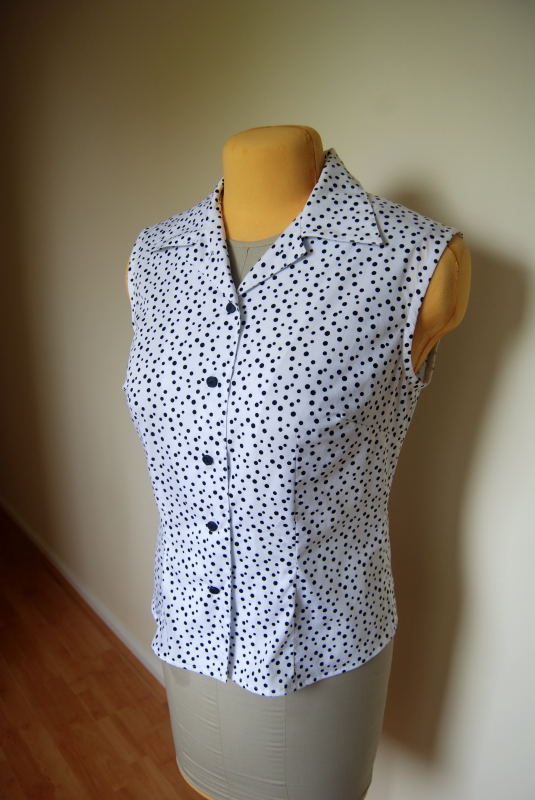
I still had yardage leftover, even after cutting a circle skirt and a sleeveless blouse. What to do? What to do? I decided to make a "wearable" muslin from this new pattern, well, as least new to me.
This is Vogue V8689. It's a tailored shirt with two collar variations, two lengths and three different sleeves. It also comes in B,C, and D bust drafts. It's a Vogue Pattern, a company which as always been reliable for me. The versatility would give me 12 different style variations, quite enough for a tailored shirt.

Although, there is no such thing as a wearable muslin, I was quite willing to attempt this new pattern with nothing more than a quick check of the pattern pieces on my dress form and see if I got a decent fitting shirt out of my time. In my experience, Vogue does a good job with pattern drafting, particularly with these wardrobe building patterns. I'm hoping for a standard shirt pattern that will be with me for decades.
This is Vogue V8689. It's a tailored shirt with two collar variations, two lengths and three different sleeves. It also comes in B,C, and D bust drafts. It's a Vogue Pattern, a company which as always been reliable for me. The versatility would give me 12 different style variations, quite enough for a tailored shirt.
Although, there is no such thing as a wearable muslin, I was quite willing to attempt this new pattern with nothing more than a quick check of the pattern pieces on my dress form and see if I got a decent fitting shirt out of my time. In my experience, Vogue does a good job with pattern drafting, particularly with these wardrobe building patterns. I'm hoping for a standard shirt pattern that will be with me for decades.
Here's the result to the right.
Garment Finish: A
The pattern was straight forward and easy to work. I made all the seams flat felled and the blouse is nearly as nice inside as out.
Fit: A
Excellent fit. I used the C cup draft and I had no problems with the front packet gaping at the bustline.
Material Choice: A
Just as the last project, this printed cotton was a good choice for ease of construction.
Style and Wearability: A
The shirt is great wardrobe extender. It can be worn with jeans, skirts, and shorts.
Overall: A Nailed it! I will file this pattern with my gold standards! Vogue 8689 is well worth the investment even at full price. This is a classic tailored shirt for any wardrobe.
The pattern was straight forward and easy to work. I made all the seams flat felled and the blouse is nearly as nice inside as out.
Fit: A
Excellent fit. I used the C cup draft and I had no problems with the front packet gaping at the bustline.
Material Choice: A
Just as the last project, this printed cotton was a good choice for ease of construction.
Style and Wearability: A
The shirt is great wardrobe extender. It can be worn with jeans, skirts, and shorts.
Overall: A Nailed it! I will file this pattern with my gold standards! Vogue 8689 is well worth the investment even at full price. This is a classic tailored shirt for any wardrobe.
Thursday, September 17, 2015
Starting to Pick up Momentum Again: McCall's 2094
I finished the inside with french seams. They are not tiny, but a sporty blouse in a crisp cotton can carry a bit of width in the seams. They are certainly narrower than the normal 5/8 inch with a over lock finish. Below it the finished blouse and my evaluation.
The crisp cotton was easy to work with and I've made this pattern five or six times.
Fit: A
The redraft to a D cup solved all my fitting issues.
Material Choice: A
It was a printed dress weight cotton, not a quilting cotton. It ironed crisply and I expect years of wear from this fabric.
Style and Wearability: A
I love this type of shirt. It goes with jeans, skirts, and shorts.
Overall: A A good success!
Monday, August 31, 2015
Reflections on Wardrobe, Idea Notebook, and Lifestyle
This post is the seventh in my series Sewing 101. We are nearly to the end of my first sewing series.
If you have been following along, you have had some time to edit and review your wardrobe, collect images for an inspiration notebook and think about your lifestyle parameters. You should never consider that these three projects are of the type that once completed they are forever finished. We are not the same people we were 10 years ago and we are not going to be the same people we are now. These areas, wardrobe, inspiration and lifestyle, should be re-evaluated on a regular basis. You may decide that you need to do this every season, but you should at least think carefully once a year about your clothes.
Now you need to take what you've learned about yourself and your clothes, and make some shopping goal and sewing goal lists. Why both? Because if you are learning to sew, you should not be making jeans, you should be buying them and if you already own five straight black skirts, you should consider a print blouse instead.
Let's consider this example.
After cleaning out your wardrobe of all the clothes that don't fit, you find you're lacking in real basics. You need a raincoat, blue jeans, a skirt for work, a blouse, several tee shirts and PJ's. Here the priorities should be buying the coat and jeans and all your work clothes. Some of the tees and PJ's could make perfect beginners sewing projects.
Look at your idea notebook and lifestyle parameters to narrow down what types of clothing you will need to buy or sew.
A city raincoat that works with your business suit is very different that the barn coat you wear on a farm or the waterproofs you need to wear while running. Jeans for night-clubbing are very different than jeans used for carpentry work. Write up your shopping list with these parameters in mind. See how this focuses your clothes shopping and reduces impulse buying.
Here's my cardinal rule for clothes shopping and fabric buying. DO IT ALONE! Only you and you alone can take the time to make good decisions. Leave everyone at home, don't combine shopping for clothes with other errands and please don't shop with your friends. Make a date with yourself and keep it.
BUT.....What happens when you are out with friends and everyone gets sucked into shopping? We've all done it and it can be a lot of fun, but how do you avoid buyers regret and still not be a "party pooper" by not buying a thing. Make a list now for your purse or wallet. There are things that can be purchased "with friends" that won't be wasteful of your time and dollar. I find hosiery, accessories, and tee shirts or simple blouses the easiest to put on this list. I list sizes and colors on my 3x5 card and stick to it. For example, nude pantyhose are a yes, black smiley face toe socks are a no. A solid color tee within my color family is yes; a novelty print tee with a tie-dye background is a no, even if it's in the 2 for a $10 bin.
You should use these same criteria to develop your shopping lists for your first sewing projects. I find the fabric store much more difficult to negotiate that the shopping mall. It takes very little for me to fall off the crazy cliff and acquire very inappropriate yard goods just because they are beautiful when in all honesty I do not need a gold lame or cashmere wool.
So the moral of this post is plan now, write your lists and do far less crying later.
Sunday, August 9, 2015
In Which I Lost My Sewing MoJo....
Dear Readers,
It is with deep regret that I post again and confess that sometimes my sewing nearly does me in. This is the sad story of an unfortunate project that has haunted my sewing room and closet and mind for over three months. It is time now to come clean and move on.
I purchase my first Japanese pattern book this spring, "Feminine Wardrobe" by Jinko Matsumoto. (ISBN: 978-1-78067-124-6) It was one of the few available in my area in English and where the projects didn't look to young or to "thin". In other words, there were a couple choices that might be alright for me.
I chose this project. It's a shift dress. I thought I'd look at a properly drafted shift after my mediocre attempt of self-drafting with my retro Vogue look. It's called the ribbon shoulder shift in Matsumoto's book.
I chose to make this in size L. It should be noted that the traced patterns are net patterns. You have to add the seam allowances! I chose a linen where the warp was cream thread and the weft black. The fabric registered as a greyish tweed. You can see some of here in the corner of the first photo.
The directions in the book are very good and easy to follow. The drafting is precise. The dress went together like a dream. Everything worked! I was very pleased with the pattern.
Until....I put the dress on. All of the life drained out of me in less that 3 seconds. There standing before the mirror was an overgrown house elf wearing a grey pillow case. Dear God, what an unholy mess! This is perfect example of A+ execution and D- fashion sense. The dress is relegated to wearing on excessively hot and humid days, after my shower and before my PJ's....but only reluctantly. It really should go straight into the bin as it doesn't look good on me. Really, it's much worse that this photo makes it out to be and wearing it makes me feel like an zombie extra in a post apocalyptic low budget film.
Let me make myself perfectly clear, I really don't have any complaints against the book or pattern itself. I got exactly what was pictured and on me, that wasn't good.
Garment Finish:
A The pattern was easy, clear and precise.
Fit:
B- Considering my bust, a Japanese large size, was okay.
Material Choice:
D - I made a poor color choice and the linen became limp and soft on washing.
Style and Wearability -
F The shift is not for me body type! Move away from this silhouette!
Overall: C- I need to move on.
....and it was the moving on that proved the greatest inertia in my work room this spring. I just couldn't bring my self to risk another style disaster like this one. And so I've spent nearly three months gathering the scattered sewing mojo from between the threads on the sewing room floor.
Sunday, May 10, 2015
Slim Chemise Dress in Blue
I remade the 1952 Vogue 7231 again in a blue cotton linen blend. It's better, but I still have the collar issues with this one. I need to learn some more about pattern drafting. Here it is on my dress form and that's all we need to say about it. This dress is nice enough for housework but that's about it. I will not be putting this into the permanent pattern file.
Hey Vogue! How about redrafting this one for the 21st century?
Sunday, April 12, 2015
Chemisier B by Tonje Thorensen
This is another stash busting project. I had some black and white printed cotton and an inexplicable need to mix my French language lessons with my sewing. Hence, I give you "Chemisier B" by Tonje Thorensen or rather as she describes it "Chemisier à col rond et manches à revers". (Blouse with round collar and reversed sleeves)
Thoresen, Tonje, and Catherine Guidicelli. Couture Vintage. Paris: Hachette Pratique, 2013. Print.
This pattern book, as with all my French pattern books and magazines, assumes you know your way around the haberdashery store, the sewing room and your fitting skills. There are no lengthy explanations or hand holding with these patterns. They are guide lines only. Your success is up to you skill depth. Now, having said this, I did have very good success with this pattern book and I'd be willing to try again.
This is a simple cotton blouse with a self-facing button front. It has set in cap sleeves with a reversed cuff finish. The collar is banded with a simple rounded collar. The bodice is fitted with a shoulder dart and waistline tucks in the front and back. Sizes in this pattern book range from EU 36 to EU 44. All sizes are shown on the pattern sheet for each pattern piece so that grading between sizes would be very easy to do. I traced the EU 44 size just as the book drafted it, before doing a pattern pin fitting. I decided to go ahead with the 44 without changing the pattern.
There were two things that I had to very aware of with this pattern. The seam allowances had to be added to the pattern and they were not the same width everywhere. I had to toss out the 5/8'' everywhere rule and remember the different widths for different purposes system. I can see getting very used to this and automatically knowing where to cut larger allowances for better fitting. The second smaller problem was that the front and back of the sleeves and cuffs were very, very similar in shape. Careful marking and careful organization will save mix ups in this area.
Here's the finished garment on me. This photo was taken between gusts of freezing rain. I was not a happy camper for most of the March in terms of the weather.
Garment Finish: The fabric was a printed cotton and I serge finished the seam allowances and hem edges. I also used an iron-on interfacing. The cotton pressed easily and gave the blouse a crisp finish. Grade: A-
Fit: Good fit and easy adjustment with the waistline tucks. Grade: A
Material Choice: Printed cotton is always a winner for ease of construction. Grade: A
Style and Wearability: I love the print, but I'm not so crazy about the sleeves. Grade: B
Overall: A-
Next time, I think I'll try the Blouse à col Cravate in a silk print.
Wednesday, April 8, 2015
Shopping Bags or Something from Nothing
Today's post is about this kind of sewing that must be done, rather that the sewing that we all wish we could be doing. It's about the utilitarian sewing that fills most of my sewing days. Although, I'd much rather be dreaming up a brand new cocktail dress, what really needs to be done is the mending, and the hemming, and the remaking of worn clothing and the making of utility shopping bags.
My shopping bags get used and abused and they wear out. I needed new ones before I began losing my weekly shopping in drips and drabs through holes that had become too big to mend.
This is a stash project; a perfect excuse to use fabric that just wasn't right for the original purpose. I had some brown denim-like material, that didn't wash well and was too stiff to use as a winter skirt. That's the brown stuff. I also had miles of leftover bias-cut quilting cotton from a mistake I made in arithmetic when finishing a quilt. That's the green stuff. Finally I had a good handful of stitch witchery left over from my Ikea curtains that was the exact width of the bias tape. That stuff is unseen on these photos.
I measured up my old shopping bags before tossing them directly in the trash. I simply transferred these measurements plus a seam allowance to the brown fabric and cut on the straight lines. I first hemmed the top of the bag front and back as well as the piece that was cut for the sides and bottom.
Next I estimated the strap length as twice the bag height plus the handle length. I cut four of these for each bag. I then used my stitch-witchery to "glue" two of the straps together. I edge stitched each strap before attaching it the bag. This produced a strong, sturdy strap with not much stretch. I top-stitched each strap the the bag from and back
After the strap was in place, I sewed the continuous sides and bottom piece to the front and back. To make this as easy as possible I placed wrong sides together and sewed leaving the seam allowance showing to the right side. This gave me a finished interior to the shopping bag. Finally, I used some more bias tape to enclose the raw seam on the outside. This second stitching of the bias to this seam gave me a strong seam and a finished look to the bag, both inside and out.
So, two shopping bags and some more space in my stash. Is it time to go fabric shopping again?
Subscribe to:
Comments (Atom)
Old Cookbook Menus
These two days of menus come from a 1945 cookbook written by Vera Bradely. The book has an entire years worth of suggestions for three meals...
-
Now, it is nearly March. The winter was a tough one and it is not over yet. Weather and health were the two main foci. The snow and ice have...
-
Yesterday was successful, but not the the ways I expected. The external chores, those pertaining to shopping, banking, and the pharmacy wen...