The last several sewing projects have used two pieces of yard goods bought for two projects, a circle skirt and a shirt dress. By using every last scrap, I also gained three shirts out of the same yardage lengths. Three extra garments gained from the waste of two. This is incredible to me. I checked my purchase receipts and original lengths and pattern requirements and although a little extra was given to allow for straightening the yard goods, there was just that much waste.
All this waste is rather disturbing to me, especially in light of today's economic conditions, few of us have anything to waste any longer. Also, given that one of my research hobbies is reading about the economic hardships of the WWII householder, the very idea of being lead into purchasing enough fabric for three additional items of clothing was shocking.
I did some research on the War Production Board in the US during WWII. This government organization directed US industries from peacetime to wartime production. It had its hands in every part of the US economy from warships and parachutes to scrap metal drives and civilian rationing. They even issued guide lines for the amounts of fabric allowed in various items of clothing. These guide lines were used by manufacturers and clothing became more tailored and slim. Hemlines rose, pleats were forbidden and pockets were limited to one per garment. There were no such restrictions on home sewing and its popularity rose.
Here are some of the fabric restrictions from the WPB for some of my recent projects.
Daytime Dresses - Women's sizes - Length, 45". Sweep of Hem, 74".
- Misses' sizes - Length 43". Sweep of Hem, 78".
Blouses - Sleeve Width limited to 14" for size 32". Length from neck to hem, 22". Only one patch pocket.
Skirts or Culottes - Women's sizes - Length 28 1/4" to 30". Sweep, 66" to 97"
- Misses' sizes - Length 26 1/4" to 28 1/2" Sweep 60" to 84"
Prohibited: Dolmon, balloon, leg o'mutton and bias cut sleeves. All-round pleated skirts. Wide belts, aprons and tunics.
Straight Coats - Women's - Length, 44". Sweep of Hem, 64".
- Misses' - Length 42". Sweep of Hem, 60".
Fitted Coats - Women's - Length, 45". Sweep of Hem, 64".
- Misses' - Length 43". Sweep of Hem, 70".
It is interesting to note that the length of the day dress could be longer than a straight coat. I guess your dress hem peeked out from your coat. It is also interesting to note that nearly all my sewing projects fail these standards, mostly in length.
Tuesday, January 19, 2016

Friday, January 15, 2016
Back to Success; Vogue 8689 Again
 The previous project, the Butterick shirt dress, B6091, left me with lots of left over fabric. This particular fabric was generous in the width and all those godets in the shirt dress skirt were not fabric saving in any way. I had enough fabric left over for a shirt with sleeves!
I immediately went back to my newest pattern Vogue 8689. Patience and organization allowed me to cut a three-quarter sleeved shirt which will be perfect for my Saturday jeans.
I needed to piece the back yoke, but that was the only change I had to make in order to cut all the pieces. A quick basting and a flat felled seam solved the problem and I was neatly on my way.

I used flat felled seaming through out construction.


The cotton fabric and pattern performed beautifully.

An absolute success! A+ across all categories.


I think I'm going to see a lot of Vogue 8689 in my closet after this!
Monday, January 11, 2016
In Search of a Shirt Dress....

This is Butterick B6091. It's good, but not perfect. This pattern is has a fitted bodice with princess seams. The collar is two piece and there are three sleeve variations, sleeveless, short-sleeved and three-quarters sleeves. I really wanted this pattern to work because it had side seam pockets and a concealed button placket closing. I loved the full skirt and the three-quarter length sleeves. This pattern had it all going for it.
Garment Finish: I chose a light colored retro cotton print. The print reminded me of a favorite printed dress I had in elementary school. Again, the fabric was very easy to work. Pressing was easy and I finished the seams with either a french seam or a serged finish. Grade: A-
Fit: There are some issues with this dress. After checking the pattern fit on my dress form, I decided I needed to shorten the bodice to the petite length. I did not do a FBA for this pattern. Otherwise, I made this pattern as drafted by Butterick. Grade: C-
Material Choice: Printed cotton. Grade: A+
Style and Wearability: It is a wearable shirt dress, but I'm not in love with the specific style of this pattern. There were a lot of thing to love about this dress. The three-quarter length sleeves are just right for housework. They stay out of the mess of house work, yet never are untidy. I always want pockets for all the flotsam of housework. I need places to put the untidy bits of life until I come around to their proper places. I loved the covered placket for the front closure; nice and neat.


I shortened this pattern to a petite bodice length, maybe I shouldn't have but this adjustment put the narrowest part of the dress at my waist, the narrowest part of me, right? Not quite I think...the large bust and the very full skirt created a curvy silhouette that just didn't work for me. I need simplicity in either the top or the bottom and the full skirt and the fully tailored shirt top seem to fight with each other. I think if I did this again I would redraft the skirt to be narrower, perhaps without the godets.

Final Grade for the Dress: B- This project is not a wadder, but it doesn't give me any joy to wear. The dress is perfect for housekeeping, but the pattern is not a keeper. The search for the perfect shirt dress continues.
Thursday, December 24, 2015
Merry Christmas to All!
 |
| The Mantle |
 |
| The Tree |
 |
| The Grinch Left Cookies! |
 |
| The Kitchen |
 |
| Merry Christmas from Whoville! |
Wednesday, December 23, 2015
The Who's have been singing.

This morning I heard the Who's singing. They have been busy this week. It has been very warm this year and they have brought blooming grickle grass for the holidays. They've decorated my mantle wreath and dropped off some Whoville wrapping paper.


I even caught one of them in the tree.

Monday, December 14, 2015


Sunday, December 13, 2015
Mr. Grinch Pinching the Last of the Holiday Decorations.

With the help of the internet and Pinterest, along with a bit of foam core board, some poster paint, a Sharpie marker and an Exacto knife. I came up with this for the front door. The wreath, I had purchase many years ago, is a plastic "boxwood" wreath which will not scratch up the door. Mr. Grinch's hand is secured to the wreath with a couple of produce bag twist ties from the junk drawer.

Friday, December 11, 2015
A Pause in the Sewing...for Christmas
 Dear Readers,
December has come, dark, rainy, wet, miserable December. A month better designated for hibernation than celebration. Yet, in someone's ancient wisdom, the second most important holiday in all of Christendom is celebrated during the darkest, wettest, most miserable time of the year. I'm not a fan....that is to say I'm not a fan of Christmas in December.
I often wonder if I would have had a better attitude toward this holiday had I been born Australian. In some ways, summer BBQ's, beach parties and fireworks seem more in keeping with a joyous birthday occasion, rather than rain.... and ice...and snow.
But never fear, I was lucky enough to have been born just post Geisel Seuss and my childhood was filled with such characters and Horton, Yertel, and the Lorax, but most beloved of all was the Grinch, a man after my own heart. Ultimately, the Grinch does come to understand the true meaning of the Christmas, but in my mind he also allows me to be a true wet blanket about the entire period leading up to the holiday. We can't even get beyond clearing out the Halloween when the retailers are pumping "Silent Night" by Alvin and the Chipmunks through out the stores inviting us to up our consumer debt. Frankly, I vacillate between morose depression and grenade lobbing rage during the time leading up to this holiday. I think that we really should be quietly tucked in our beds for a long winter's nap only to emerge about Groundhog's day for a two week ski and spa experience; then, and only then, should life begin anew. But, this is my fantasy; reality is always something else.
This year, the winter blues aren't nearly as great, perhaps it's due to an unusually dry and sunny winter, in which case, thank the Lord for global warming. (Sarcasm, please people!) I have rested myself from my midwinter stupor and channeled my inner kindergartner and Geisel Seuss into decorating the house.


A day or two later I added some paper snowflakes cut from leftover scraps of pattern tracing paper from my sewing room. The two red stars were cut from a single piece of scrap booking paper and the blue ornament is one of those long forgotten things we all have tucked away for sentimental purposes. I thought the season's decorations were complete.....but then Mr. Grinch started working on my teeny, tiny pre-Christmas heart....Oh, you're a mean one, Mr. Grinch!
Tuesday, December 8, 2015
Sewing to Save Money

Many old sewing books begin by making some sort of statement to the effect of, "It is good economy to be proficient at sewing." Let me state right up front, if you think you are going to learn to sew in order to save money on making your entire wardrobe, you are dead wrong. The time, materials and equipment needed to learn to make all of your clothes from panties to overcoats far out weighs the cost of smart shopping in the first place. The proliferation of cheap ready to wear fashion has changed the balance of the equation for "Will I save money if I learn to sew?" The answer is sometimes.
Learning to sew requires investment in time and equipment and an ability to self-evaluate one's own limitations. It can be a fun and rewarding hobby and sometimes, it can save you money.
Here's what I have learned about saving money and sewing.
Sometimes there is a time and a place in your wardrobe for cheap clothing. For example, a sports team tee shirt, or gardening clothes are examples where a sale at a discount store or a rummage through a thrift shop will be far cheaper than sewing your own. A fashion fad or holiday wear to an exotic climate are other examples. I will not be sewing my ski anorak or my swim suit; they was purchased inexpensively at a discount sports store and are worn only during a two week holiday once a year.
Sometimes high quality retail goes on sale and is well worth the cost. Blazers, overcoats, and tailored slacks, all fall into this category. It is well worth learning enough about clothing and clothing construction to be able to recognized good quality at retail and consignment shops. Thankfully, the modern Internet provides a lot of information about how good quality clothing is constructed and how is should be finished. This allows a savvy buyer to make informed decisions about their wardrobe without actually sewing any of it.
Sometimes sewing make perfect sense. You can save a lot of money by learning simple repairs. Learn to sew on a button neatly. Hand stitch a small rip in a seam. Secure a fallen hem. All of these will save you money and extend the life of your garments. These sorts of repairs only require the kind of equipment that will fit in a small box and they will pay for themselves easily. However, repairs do take patience, time and practice and yes...the button sewn on to your coat with dental floss in the airport lounge will look exactly that ...sewn on by a left-handed drunken monkey, but you will not have lost the button. Take care of it properly as soon as you can.
Learning some simple tailoring will save you money. Learn to hem pants and skirts. Shortening and lengthen blazer sleeves is well worth the time, if you have purchased a garment that can be altered in the first place. Moving buttons, shortening and lengthen skirts and adding adjustable elastic to waistlines will help with extending the life of children's clothing.
Sometimes there is no other choice but to sew if you have a figure that is hard to fit. For me, blouses and fitted dresses fall into this category. I prefer the fit of blouses that do not gap at the bust nor drape over the shoulder line, to get this I sew.
Sometimes sewing is well worth the investment. Home decor is still by far the easiest place to make a high impact on your budget. Curtains, duvet covers, pillow shams, table linens are all easy projects that at most require patience, accurate measuring, and straight line sewing. This is a great place to get started to see if you like the creative sewing process and build your bank of sewing skills before moving on to clothing. Even in this area you should be honest about your skill level. Cotton valances in a child's room, a bed skirt, or a holiday table runner are great beginner projects. Velvet lined two story drapes for the drawing room and a plaid slip cover for the lounger in the den are not the place to start.
Sometimes you need to sew to exactly what you want. Style and fashion is dictated by store buyers. What happens if this season's colors and styles are not yours. Do you prefer eggplant when the world is wearing lilac? Are hem lines just too short? I know my middle aged knees need a bit a fabric to my skirts, but heaven help me if the hemlines are thigh high at the retail store. This is when I sew.
Remember that sewing will bring you high quality garments that can far out last cheap ready to wear. If you find good quality cotton sheets at a consignment shop, nightwear made from these will last for years and still look good after many wearings. A fully lined wool tweed pencil skirt should not be compared in price to a polyester-blend Worthington woman's suit from JCPenneys. It just isn't in the same category. It should be instead compared to an item in a high-end designer boutique or from a custom atelier. It is only then, when comparing apples to apples that savings are made by sewing.
Finally, do not walk away from reading my first series on learning to sew thinking that I have purposely set about discouraging you. On the contrary, I think everyone should learn the basics of sewing. I think everyone should read information about how clothes are constructed and what makes good quality fabric from bad. I think everyone should be proficient with small hand sewing repairs and simple machine alterations. I also think many people should learn to make or at least alter simple curtains and other home furnishings. But do I categorically, believe that you will save money by sewing your own clothes over shopping smartly? No! It is a balance in which your own love of sewing with its emphasis on creativity must be greater than the money saved on each and every project. Sewing is my hobby, I spend time and money on my hobby, just as someone who paints watercolors or scuba dives, and sometimes I save a bit of money on my wardrobe.
Monday, December 7, 2015
Three pieces - Five Outfits
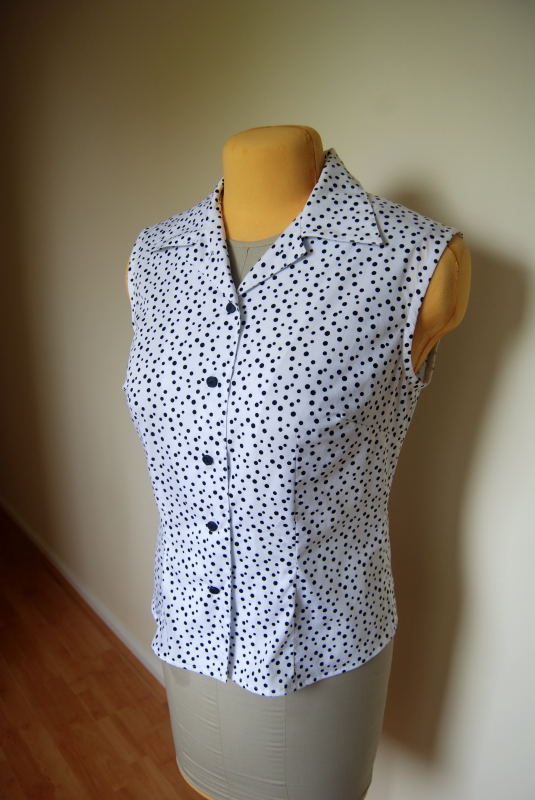


Here are the three pieces I made out of the black and white dot. I could wear each seperately or I have two summer weight dresses also. This is a real wardrobe extender for a good piece of neutral fabric. I gleaned this idea from a old sewing book. I had originally 4 meters of yard goods about 60" wide. Out of this, I was able to sew a circle skirt, which is a huge waste of fabric yardage as well as the two blouses shown above. As you can imagine, these black and white dots are going to show up at least once a week in my summer wardrobe, so the warning is... "chose a versatile and well-like fabric because you will wear it again and again and again."


Monday, September 28, 2015
Still more Dots - Vogue V8689

This is Vogue V8689. It's a tailored shirt with two collar variations, two lengths and three different sleeves. It also comes in B,C, and D bust drafts. It's a Vogue Pattern, a company which as always been reliable for me. The versatility would give me 12 different style variations, quite enough for a tailored shirt.

Although, there is no such thing as a wearable muslin, I was quite willing to attempt this new pattern with nothing more than a quick check of the pattern pieces on my dress form and see if I got a decent fitting shirt out of my time. In my experience, Vogue does a good job with pattern drafting, particularly with these wardrobe building patterns. I'm hoping for a standard shirt pattern that will be with me for decades.
Here's the result to the right.
Garment Finish: A
The pattern was straight forward and easy to work. I made all the seams flat felled and the blouse is nearly as nice inside as out.
Fit: A
Excellent fit. I used the C cup draft and I had no problems with the front packet gaping at the bustline.
Material Choice: A
Just as the last project, this printed cotton was a good choice for ease of construction.
Style and Wearability: A
The shirt is great wardrobe extender. It can be worn with jeans, skirts, and shorts.
Overall: A Nailed it! I will file this pattern with my gold standards! Vogue 8689 is well worth the investment even at full price. This is a classic tailored shirt for any wardrobe.
The pattern was straight forward and easy to work. I made all the seams flat felled and the blouse is nearly as nice inside as out.
Fit: A
Excellent fit. I used the C cup draft and I had no problems with the front packet gaping at the bustline.
Material Choice: A
Just as the last project, this printed cotton was a good choice for ease of construction.
Style and Wearability: A
The shirt is great wardrobe extender. It can be worn with jeans, skirts, and shorts.
Overall: A Nailed it! I will file this pattern with my gold standards! Vogue 8689 is well worth the investment even at full price. This is a classic tailored shirt for any wardrobe.
Subscribe to:
Posts (Atom)
-
How many times have you opened your closet door and sighed, "I haven't got a thing to wear," yet the rack is over stuffed with...
-
 Dear Readers, December has come, dark, rainy, wet, miserable December. A month better designated for hibernation than celebration....