The next project is Butterick B4659. It's a simple blouse pattern with not to many details. I redrafted the sleeve to have a simple buttoned cuff, but other than that I made the pattern up in a size 16.
Here is the blouse in mid-construction. I chose a white poly-cotton blend fabric from my stash as an inexpensive choice for my first attempt for this garment. Looking at this photo, I have concluded that I should really photograph the projects and look at the photos during the construction process. I seem to have a blind eye to fit details in the workroom that scream at me in the photos. I really wonder why that is? The photo on the right shows that the shoulder is much to wide. This is a problem with many patterns as they scale up. The shoulder scales up far less than other parts of a woman's body, for example her waist or bust.
This this the finished blouse. It's wearable, but the shoulders droop at least an inch off the shoulder line. This will have to be redrafted before doing this again in a better fabric. This photo also shows the main draw back of the poly-cotton. It will not press crisply and it will wrinkle and pucker in the seams after washing. The blouse looks fine under a blazer, jacket or sweater which is what I needed it for in the short term. For the long term, I think a redraft of the shoulder width is a good time investment because the collar sits well on me.
Friday, March 4, 2016
Saturday, February 27, 2016
Quilting
Several years ago, I had the unfortunate pleasure of a very long recovery from an illness. Weak and ill-tempered, there wasn't much I was able to do for many weeks and McKenna Ryan came to the rescue.
I had purchased several of her small quilts as kits from a clearance sale at my local quilting store and had put them away as aspirational projects.
I got them out during this recovery period and proceeded to cut out and iron-on the hundreds of individual pieces in about thirty different shades of green, rust and grey. When I got to the quilting stage, I couldn't yet sit that long at the sewing machine, so I put them away and life took over. I recently found them again and with a few pointers from my sister, the master quilter, here is my first attempt at free motion quilting. It's good enough as a start or experiment, but it really isn't my favorite sewing pastime. This is the first of five; there are four more to finish.
I had purchased several of her small quilts as kits from a clearance sale at my local quilting store and had put them away as aspirational projects.
I got them out during this recovery period and proceeded to cut out and iron-on the hundreds of individual pieces in about thirty different shades of green, rust and grey. When I got to the quilting stage, I couldn't yet sit that long at the sewing machine, so I put them away and life took over. I recently found them again and with a few pointers from my sister, the master quilter, here is my first attempt at free motion quilting. It's good enough as a start or experiment, but it really isn't my favorite sewing pastime. This is the first of five; there are four more to finish.
Monday, February 22, 2016
Tuesday, February 16, 2016
Wardrobe Planning - Orphan Garments
How many times have you opened your closet door and sighed, "I haven't got a thing to wear," yet the rack is over stuffed with hangers and the floor is littered with shoes. Too often we have plenty of clothes, but nothing suitable for the intended occasion. It may be an old joke having to many clothes and nothing to wear, but it is hardly funny.
We all ignore common sense when planning wardrobes and we can't resist the newest fashion trends. We spend very little time on learning what is really becoming to us. If we do learn this at one time or another, we often fail to update our look as we age. I cannot wear the colors and styles of my youth, or of my early working career. My shape and coloring have changed as I have aged and my wardrobe has too.
Plan carefully include all the day to day business, home life and social activities you participate in in your planning. With thought, you can actually reduce your wardrobe size while extending its' versatility.
Extending your wardrobe does not mean creating an all inclusive mix and match closet nor does it mean having a drawer full of accessories for your little black dress.
Careful planning means choosing items that can have a wider variety of use and changing and replacing only a few items each year to update your look. Finally, let us be rid of the notion that we can never wear the exact same outfit twice in the same season or month. For heaven's sake, ladies, if you look absolutely great in an outfit wear it twice a week!
Everyone has a skirt, jacket or other item that they wear only occasionally and those items tend to go out of style before you get good service from them. They become orphan garments in your wardrobe and ultimately money wasted from your budget. Find these items. Try them on. Do they fit? Are they fashionable? Do you love them? If you can respond honestly "yes" to all three of these questions. Then consider readopting these orphans back into your wardrobe by adding just a few key items. Take a serious inventory and see what your really need.
Here are some examples.
A basic dress and jacket combination can be mixed and matched by adding a tailored skirt to blend with the jacket. Add a print blouse that blends with the jacket and tailored skirt. Finally, consider a pretty gathered skirt in the same print. The printed blouse and skirt can be worn together as a dress and the jacket will now go with the original dress, the new tailored skirt, and the printed skirt and blouse.
A soft tailored suit will get extra mileage with a new solid tailored sleeveless top and again add a skirt and blouse in a muted print. Make the blouse short sleeved for warm weather and perhaps choose an solid color cardigan as another option to the suit jacket.
A casual jacket and pleated skirt can get more wear with pants or shorts added to the mix. Try adding a slim skirt in a contrasting color with a matching blouse for more options.
Beyond the LBD....we all have one and often it's just what is needed for a formal event, but there are times and places where your LBD is not welcome. What then? The cocktail suit is a smart option. This is a dressy, less tailored suit in a beautiful, formal, but classic fabric, something like solid silk shangtung. Add a contrasting colored sleeveless shift blouse to wear with the suit skirt and then add a full length skirt in a darker pastel to give extra wear to either the blouse or jacket. A chiffon shirt blouse further extends your options as does a chiffon skirt in a pretty, but subtle, print.
We all ignore common sense when planning wardrobes and we can't resist the newest fashion trends. We spend very little time on learning what is really becoming to us. If we do learn this at one time or another, we often fail to update our look as we age. I cannot wear the colors and styles of my youth, or of my early working career. My shape and coloring have changed as I have aged and my wardrobe has too.
Plan carefully include all the day to day business, home life and social activities you participate in in your planning. With thought, you can actually reduce your wardrobe size while extending its' versatility.
Extending your wardrobe does not mean creating an all inclusive mix and match closet nor does it mean having a drawer full of accessories for your little black dress.
Careful planning means choosing items that can have a wider variety of use and changing and replacing only a few items each year to update your look. Finally, let us be rid of the notion that we can never wear the exact same outfit twice in the same season or month. For heaven's sake, ladies, if you look absolutely great in an outfit wear it twice a week!
Everyone has a skirt, jacket or other item that they wear only occasionally and those items tend to go out of style before you get good service from them. They become orphan garments in your wardrobe and ultimately money wasted from your budget. Find these items. Try them on. Do they fit? Are they fashionable? Do you love them? If you can respond honestly "yes" to all three of these questions. Then consider readopting these orphans back into your wardrobe by adding just a few key items. Take a serious inventory and see what your really need.
Here are some examples.
A basic dress and jacket combination can be mixed and matched by adding a tailored skirt to blend with the jacket. Add a print blouse that blends with the jacket and tailored skirt. Finally, consider a pretty gathered skirt in the same print. The printed blouse and skirt can be worn together as a dress and the jacket will now go with the original dress, the new tailored skirt, and the printed skirt and blouse.
A soft tailored suit will get extra mileage with a new solid tailored sleeveless top and again add a skirt and blouse in a muted print. Make the blouse short sleeved for warm weather and perhaps choose an solid color cardigan as another option to the suit jacket.
A casual jacket and pleated skirt can get more wear with pants or shorts added to the mix. Try adding a slim skirt in a contrasting color with a matching blouse for more options.
Beyond the LBD....we all have one and often it's just what is needed for a formal event, but there are times and places where your LBD is not welcome. What then? The cocktail suit is a smart option. This is a dressy, less tailored suit in a beautiful, formal, but classic fabric, something like solid silk shangtung. Add a contrasting colored sleeveless shift blouse to wear with the suit skirt and then add a full length skirt in a darker pastel to give extra wear to either the blouse or jacket. A chiffon shirt blouse further extends your options as does a chiffon skirt in a pretty, but subtle, print.
Friday, February 12, 2016
A Small Rework
I've reworked my red polka dot dress a little.
On the left is the old dress, on the right the new look. I replaced the buttons and took in the bodice darts. I've got a bit better fit and the red buttons blend into the dress unobtrusively. It's better, but the red color is more suited to summer in Belgium rather than February. The dress is going into the summer wardrobe.
My previous closet cleaning post has revealed some interesting results. I have lived out of my "spark joy" clothes for two weeks. I have retrieved only two items from my seven bags of discards. One was a brand new black cotton cardigan and the other and black and white checked scarf. The rest I don't miss in the least.
I did learn that I prefer skirts and blouses to dresses in my winter wardrobe and that can be seen by my past sewing projects on the blog. I think that trend should continue. There is one thing I am missing, white shirt. I tossed all of my old ones because their time had come. It's time for a new crisp white shirt.
On the left is the old dress, on the right the new look. I replaced the buttons and took in the bodice darts. I've got a bit better fit and the red buttons blend into the dress unobtrusively. It's better, but the red color is more suited to summer in Belgium rather than February. The dress is going into the summer wardrobe.
My previous closet cleaning post has revealed some interesting results. I have lived out of my "spark joy" clothes for two weeks. I have retrieved only two items from my seven bags of discards. One was a brand new black cotton cardigan and the other and black and white checked scarf. The rest I don't miss in the least.
I did learn that I prefer skirts and blouses to dresses in my winter wardrobe and that can be seen by my past sewing projects on the blog. I think that trend should continue. There is one thing I am missing, white shirt. I tossed all of my old ones because their time had come. It's time for a new crisp white shirt.
Monday, February 1, 2016
Not a darn thing....
I recently took part in a clutter challenge. My clothing wardrobe consists of 3 parts, summer, winter, and the core. The core clothes are things that remain year round, jeans, cotton cardigans, sneakers, ect. Winter and summer are just that, clothes that must be stored off season. I have maintained my wardrobe for years using the general rules I have laid out in seven steps in this post. I think this system has served me well for many years and I didn't see any need to change. Using this system, I had reasonable sized wardrobe and plenty to wear. I always had space for my clothes and didn't consider my wardrobe overly large or full of unwearable pieces.
I didn't believe the hype of Marie Kondo and I was challenged to it. I dumped my entire wardrobe into the guest room. Everything from everywhere went on the bed, and then the floor and the shoes spilled out into the hallway. It took half a day just to locate and collect my clothing. I will never show anyone the before pile. It was truly amazing, humbling, and shameful.
This is the first after photo, my summer wardrobe is six hanging garments, one Rubbermaid tote, 5 shoe boxes and one sweater box. A pair of Wellies and a pair of garden clogs are in the garage. (The other sweater box has a few heirlooms in it.) I am truly amazed. I am not 100% convinced yet, and the discards have not left the house....but this was starting to become a very interesting experiment.
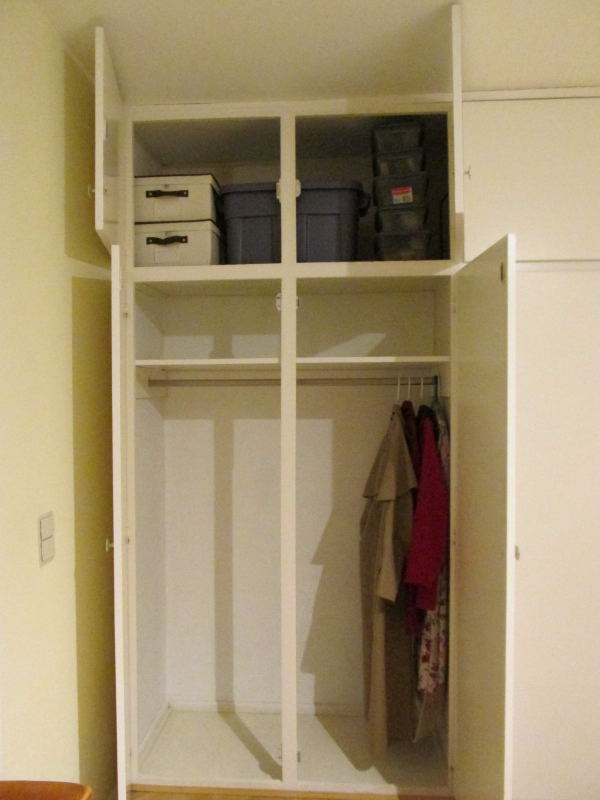
So this is the closet with the summer and core wardrobe. There is still plenty of space and nothing is crowded, but I had the winter garments to sort and add. That was not fun. Winter clothes take up a lot of space and I am unwilling to part with some clothing that I consider essential winter survival gear. I still have an arctic winter parka, my LL.Bean Hunter's boots and wool socks. I need them now and again living here, but not every winter and they certainly don't spark any Konmari joy. If I had to be critical of the Marie Kondo's method of clutter removal, there is a category of things that are absolutely essential, but completely joyless, to own. Snow survival gear falls into just that division, so does pantyhose, granny pants, and a spare pair of shoe laces.
The above three photos are the finished project. The closet contains the core wardrobe plus the winter wardrobe. The summer hanging items have been moved to a seasonal family closet which also contains other necessary but infrequently worn items such has our ski wear and heavy winter parkas. This closet will also hold our winter coats during the off season as they are hung in the front hall closet along with our boots and hiking gear. The cedar chest has my wool sweaters, half is empty for my husband's things. The chest of drawers contains underclothes and pajamas. They are in exactly two and a half drawers as this chest is also shared.
As a result of this challenge, other things happened. .I exchanged two rooms in my home. That is, the sewing room became our bedroom, and the master bedroom of the house is now my sewing room. This is because the closets in our new room function better than the old ones. The room is only two-thirds the size of the original master but everything fits and there is nothing superfluous to the purpose of this room. My husband also cleaned out his clothing.
I still have reservations about the amount of things I discarded. It was more than seven bags of clothing between the two of us and it represented about 60% of my wardrobe. I have tied those bags up tightly and put them in the guest room like some secret start of a hoard. The change of seasons for clothing is only about 60 days away. If I don't need things to be added back into to the closet, the bags will be discarded at Easter time.
There are two final results of this experiment. The first is that the contents of the sewing room is now heaped on the floor of its new home beckoning me to continue the procedure. The second result is that purpose of this blog is called into question. I invite comments from my readers as I'm not sure where my sewing hobby is going to be heading in the future as apparently I need not a darn thing.
I didn't believe the hype of Marie Kondo and I was challenged to it. I dumped my entire wardrobe into the guest room. Everything from everywhere went on the bed, and then the floor and the shoes spilled out into the hallway. It took half a day just to locate and collect my clothing. I will never show anyone the before pile. It was truly amazing, humbling, and shameful.
So this is the closet with the summer and core wardrobe. There is still plenty of space and nothing is crowded, but I had the winter garments to sort and add. That was not fun. Winter clothes take up a lot of space and I am unwilling to part with some clothing that I consider essential winter survival gear. I still have an arctic winter parka, my LL.Bean Hunter's boots and wool socks. I need them now and again living here, but not every winter and they certainly don't spark any Konmari joy. If I had to be critical of the Marie Kondo's method of clutter removal, there is a category of things that are absolutely essential, but completely joyless, to own. Snow survival gear falls into just that division, so does pantyhose, granny pants, and a spare pair of shoe laces.
The above three photos are the finished project. The closet contains the core wardrobe plus the winter wardrobe. The summer hanging items have been moved to a seasonal family closet which also contains other necessary but infrequently worn items such has our ski wear and heavy winter parkas. This closet will also hold our winter coats during the off season as they are hung in the front hall closet along with our boots and hiking gear. The cedar chest has my wool sweaters, half is empty for my husband's things. The chest of drawers contains underclothes and pajamas. They are in exactly two and a half drawers as this chest is also shared.
As a result of this challenge, other things happened. .I exchanged two rooms in my home. That is, the sewing room became our bedroom, and the master bedroom of the house is now my sewing room. This is because the closets in our new room function better than the old ones. The room is only two-thirds the size of the original master but everything fits and there is nothing superfluous to the purpose of this room. My husband also cleaned out his clothing.
I still have reservations about the amount of things I discarded. It was more than seven bags of clothing between the two of us and it represented about 60% of my wardrobe. I have tied those bags up tightly and put them in the guest room like some secret start of a hoard. The change of seasons for clothing is only about 60 days away. If I don't need things to be added back into to the closet, the bags will be discarded at Easter time.
There are two final results of this experiment. The first is that the contents of the sewing room is now heaped on the floor of its new home beckoning me to continue the procedure. The second result is that purpose of this blog is called into question. I invite comments from my readers as I'm not sure where my sewing hobby is going to be heading in the future as apparently I need not a darn thing.
Wednesday, January 20, 2016
Vogue V8352 In a Red Dot Cotton
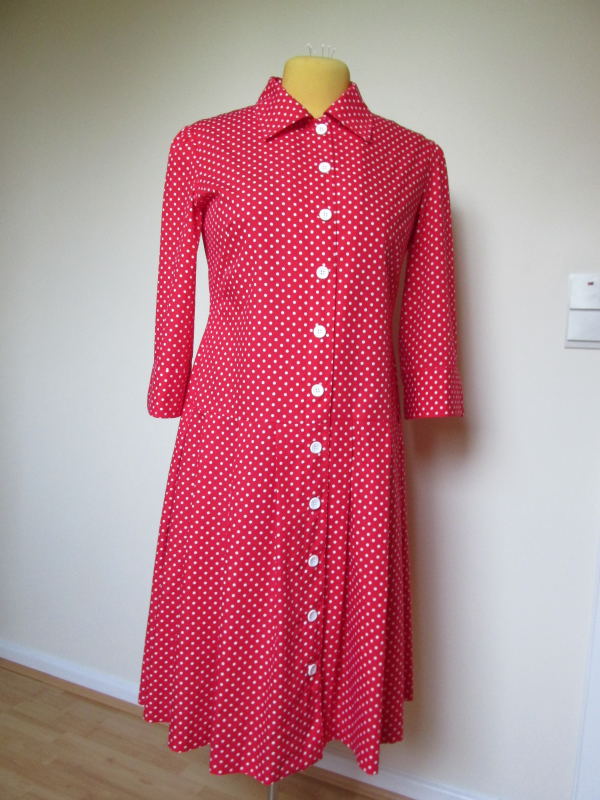
Vogue V8352 is a dress with a dropped waist and front and back darts. It has a one piece convertible collar and three sleeve variations. The skirt can be gathered or pleated.
Although not truly a shirt dress, this pattern addresses some of the problems I have with Butterick B6091. The convertible collar sits neatly closed at the throat and the dropped waist eliminates that all too curvy silhouette that I disliked so much with the Butterick pattern.
I sewed the project up in a cherry red cotton print with a white dot.
Garment Finish: The pattern was well drafted and I had no problems with construction. I used a combination of french seams and over-locked seam finishes. Grade: A+
Fit: The dropped waist covers many sins, but at the same time it does give me the look of a unfitted sack. I may take in the fitted darts again. Let's see after a couple wearings. Grade: B-
Material Choice: The cotton print gave a crisp look to the project and it was easy to sew. I do regret the cherry red for winter. The color is too bold a statement for the typical palette of grey, black, and brown in the winter here in Belgium. I definitely need to change the buttons to red. The white ones stand out too much. Grade: A-
Style and Wearabilty: It's a better dress than the Butterick shirt dress, but it still has it's problems. I think I will save my final verdict for after some adjustments in the darting and some new buttons. Right now the grade is a B-.
Overall: B There is room for improvement.
Although not truly a shirt dress, this pattern addresses some of the problems I have with Butterick B6091. The convertible collar sits neatly closed at the throat and the dropped waist eliminates that all too curvy silhouette that I disliked so much with the Butterick pattern.
I sewed the project up in a cherry red cotton print with a white dot.
Garment Finish: The pattern was well drafted and I had no problems with construction. I used a combination of french seams and over-locked seam finishes. Grade: A+
Fit: The dropped waist covers many sins, but at the same time it does give me the look of a unfitted sack. I may take in the fitted darts again. Let's see after a couple wearings. Grade: B-
Material Choice: The cotton print gave a crisp look to the project and it was easy to sew. I do regret the cherry red for winter. The color is too bold a statement for the typical palette of grey, black, and brown in the winter here in Belgium. I definitely need to change the buttons to red. The white ones stand out too much. Grade: A-
Style and Wearabilty: It's a better dress than the Butterick shirt dress, but it still has it's problems. I think I will save my final verdict for after some adjustments in the darting and some new buttons. Right now the grade is a B-.
Overall: B There is room for improvement.
Tuesday, January 19, 2016
WWII fabric rationing
The last several sewing projects have used two pieces of yard goods bought for two projects, a circle skirt and a shirt dress. By using every last scrap, I also gained three shirts out of the same yardage lengths. Three extra garments gained from the waste of two. This is incredible to me. I checked my purchase receipts and original lengths and pattern requirements and although a little extra was given to allow for straightening the yard goods, there was just that much waste.
All this waste is rather disturbing to me, especially in light of today's economic conditions, few of us have anything to waste any longer. Also, given that one of my research hobbies is reading about the economic hardships of the WWII householder, the very idea of being lead into purchasing enough fabric for three additional items of clothing was shocking.
I did some research on the War Production Board in the US during WWII. This government organization directed US industries from peacetime to wartime production. It had its hands in every part of the US economy from warships and parachutes to scrap metal drives and civilian rationing. They even issued guide lines for the amounts of fabric allowed in various items of clothing. These guide lines were used by manufacturers and clothing became more tailored and slim. Hemlines rose, pleats were forbidden and pockets were limited to one per garment. There were no such restrictions on home sewing and its popularity rose.
Here are some of the fabric restrictions from the WPB for some of my recent projects.
Daytime Dresses - Women's sizes - Length, 45". Sweep of Hem, 74".
- Misses' sizes - Length 43". Sweep of Hem, 78".
Blouses - Sleeve Width limited to 14" for size 32". Length from neck to hem, 22". Only one patch pocket.
Skirts or Culottes - Women's sizes - Length 28 1/4" to 30". Sweep, 66" to 97"
- Misses' sizes - Length 26 1/4" to 28 1/2" Sweep 60" to 84"
Prohibited: Dolmon, balloon, leg o'mutton and bias cut sleeves. All-round pleated skirts. Wide belts, aprons and tunics.
Straight Coats - Women's - Length, 44". Sweep of Hem, 64".
- Misses' - Length 42". Sweep of Hem, 60".
Fitted Coats - Women's - Length, 45". Sweep of Hem, 64".
- Misses' - Length 43". Sweep of Hem, 70".
It is interesting to note that the length of the day dress could be longer than a straight coat. I guess your dress hem peeked out from your coat. It is also interesting to note that nearly all my sewing projects fail these standards, mostly in length.
All this waste is rather disturbing to me, especially in light of today's economic conditions, few of us have anything to waste any longer. Also, given that one of my research hobbies is reading about the economic hardships of the WWII householder, the very idea of being lead into purchasing enough fabric for three additional items of clothing was shocking.
I did some research on the War Production Board in the US during WWII. This government organization directed US industries from peacetime to wartime production. It had its hands in every part of the US economy from warships and parachutes to scrap metal drives and civilian rationing. They even issued guide lines for the amounts of fabric allowed in various items of clothing. These guide lines were used by manufacturers and clothing became more tailored and slim. Hemlines rose, pleats were forbidden and pockets were limited to one per garment. There were no such restrictions on home sewing and its popularity rose.
Here are some of the fabric restrictions from the WPB for some of my recent projects.
Daytime Dresses - Women's sizes - Length, 45". Sweep of Hem, 74".
- Misses' sizes - Length 43". Sweep of Hem, 78".
Blouses - Sleeve Width limited to 14" for size 32". Length from neck to hem, 22". Only one patch pocket.
Skirts or Culottes - Women's sizes - Length 28 1/4" to 30". Sweep, 66" to 97"
- Misses' sizes - Length 26 1/4" to 28 1/2" Sweep 60" to 84"
Prohibited: Dolmon, balloon, leg o'mutton and bias cut sleeves. All-round pleated skirts. Wide belts, aprons and tunics.
Straight Coats - Women's - Length, 44". Sweep of Hem, 64".
- Misses' - Length 42". Sweep of Hem, 60".
Fitted Coats - Women's - Length, 45". Sweep of Hem, 64".
- Misses' - Length 43". Sweep of Hem, 70".
It is interesting to note that the length of the day dress could be longer than a straight coat. I guess your dress hem peeked out from your coat. It is also interesting to note that nearly all my sewing projects fail these standards, mostly in length.
Friday, January 15, 2016
Back to Success; Vogue 8689 Again
I immediately went back to my newest pattern Vogue 8689. Patience and organization allowed me to cut a three-quarter sleeved shirt which will be perfect for my Saturday jeans.
I needed to piece the back yoke, but that was the only change I had to make in order to cut all the pieces. A quick basting and a flat felled seam solved the problem and I was neatly on my way.
I used flat felled seaming through out construction.
The cotton fabric and pattern performed beautifully.
An absolute success! A+ across all categories.
I think I'm going to see a lot of Vogue 8689 in my closet after this!
Monday, January 11, 2016
In Search of a Shirt Dress....
This is Butterick B6091. It's good, but not perfect. This pattern is has a fitted bodice with princess seams. The collar is two piece and there are three sleeve variations, sleeveless, short-sleeved and three-quarters sleeves. I really wanted this pattern to work because it had side seam pockets and a concealed button placket closing. I loved the full skirt and the three-quarter length sleeves. This pattern had it all going for it.
Garment Finish: I chose a light colored retro cotton print. The print reminded me of a favorite printed dress I had in elementary school. Again, the fabric was very easy to work. Pressing was easy and I finished the seams with either a french seam or a serged finish. Grade: A-
Fit: There are some issues with this dress. After checking the pattern fit on my dress form, I decided I needed to shorten the bodice to the petite length. I did not do a FBA for this pattern. Otherwise, I made this pattern as drafted by Butterick. Grade: C-
Material Choice: Printed cotton. Grade: A+
Style and Wearability: It is a wearable shirt dress, but I'm not in love with the specific style of this pattern. There were a lot of thing to love about this dress. The three-quarter length sleeves are just right for housework. They stay out of the mess of house work, yet never are untidy. I always want pockets for all the flotsam of housework. I need places to put the untidy bits of life until I come around to their proper places. I loved the covered placket for the front closure; nice and neat.
I shortened this pattern to a petite bodice length, maybe I shouldn't have but this adjustment put the narrowest part of the dress at my waist, the narrowest part of me, right? Not quite I think...the large bust and the very full skirt created a curvy silhouette that just didn't work for me. I need simplicity in either the top or the bottom and the full skirt and the fully tailored shirt top seem to fight with each other. I think if I did this again I would redraft the skirt to be narrower, perhaps without the godets.
Final Grade for the Dress: B- This project is not a wadder, but it doesn't give me any joy to wear. The dress is perfect for housekeeping, but the pattern is not a keeper. The search for the perfect shirt dress continues.
Thursday, December 24, 2015
Subscribe to:
Comments (Atom)
Old Cookbook Menus
These two days of menus come from a 1945 cookbook written by Vera Bradely. The book has an entire years worth of suggestions for three meals...
-
Now, it is nearly March. The winter was a tough one and it is not over yet. Weather and health were the two main foci. The snow and ice have...
-
Yesterday was successful, but not the the ways I expected. The external chores, those pertaining to shopping, banking, and the pharmacy wen...