Tuesday, September 9, 2014

Simplicity 2758 - Installing an Invisible Zipper

 Installing an invisible zipper is easier than a regular zipper because all the stitching is hidden from view and any slight wobble can be forgiven. I chose an invisible zipper for the corduroy because I didn't want any top stitching showing that would crush the pile of the fabric.

      First baste the one side of the zipper upside down to the right side of a garment's zipper opening. You want the teeth of the zipper to lie just outside the seam line, so that when you unroll the zipper for stitching the zipper's stitching line is on the seam line.


  I don't have a zipper foot for my machine, I use one designed for pin tucks and it works just fine. I have to adjust the needle position and away I go. Make one smooth stitching line "in the zipper's ditch" from top to bottom. Go as far as you can toward the bottom. The zipper stop will eventually get in your way. Stitch until you cannot go any further without distorting the stitching line. Stop, back stitch and trim threads.
 

Now, align and baste the second side of the zipper. I start off by pinning the second side of the zipper in place.

I check to see I haven't got things twisted by turning the garment to the right side and closing the zip. When that works, all is right with the world and I baste the second side of the zipper and stitch as described above.

When both sides of the zipper have been stitched, I check the alignment by closing the zipper. I'm looking closely at the top edge of the skirt. This should be even and smooth for the waistband. Unevenness at the hemline can be dealt with during the hemming process.
 
 Finally, to finish closing the zipper seam, you pull the end of the zipper tape free from the seam allowances and pin the two stitching lines of the zipper together as close to the bottom as you can. Then pin the remainder of the seam. You will begin stitching at the end of  the zipper and move down, never the reverse. Begin stitching right on the end of the zipper stitch line or only one stitch length away. It can be a bit fuss, but work carefully and slowly for the first inch or so of the seam line. You're done. Trim and press and admire your beautiful invisible zipper.

Thursday, August 28, 2014

Simplicity 2758 - Coffee Corduroy

 Here's the corduroy skirt cut and ready for marking. You can see that the only unaltered piece of the pattern remaining is the underlay of the front box pleat.
I've serged the seam allowances for this skirt as corduroy fuzzes and frays wildly. Here, I'm lining up the basted front pleat, below, with the underlay piece on top. I'll need to match the seam line with the center basting line before pinning the seams and stitching.

Tuesday, July 29, 2014

The Next Two Projects - Simplicity 2758

I am pleased enough with the results of the denim skirt that I'm going to make this pattern again. This time in a fine-whale corduroy. I purchased this piece of corduroy on my last trip to JoAnn Fabrics in the US. It's a 100% cotton and coffee brown. It's has a black undertone to it rather than the reddish caste of a chocolate brown.  I also found in my stash enough fabric for a print blouse. This is a silk and cotton blend in a turquoise and brown floral print and a cream background. I purchased this piece several years ago at G-Street Fabrics in Washington, DC.


Monday, July 28, 2014

Simplicity 2758 - The Denim Skirt is Finished.

I'm pleased with the results of Simplicity 2758. The uneven hemline is because of my uneven hip line. I compensate for it two ways. I adjusted this pattern at the waist and at the hemline, making about half the needed adjustment in each place. This way I don't get too much distortion in either place. The raised hip is one reason I sew. I cannot get a ready-to-wear skirt to hang straight with reworking just the hemline. I need to adjust the waist too, at that point, I might as well sew the garment.


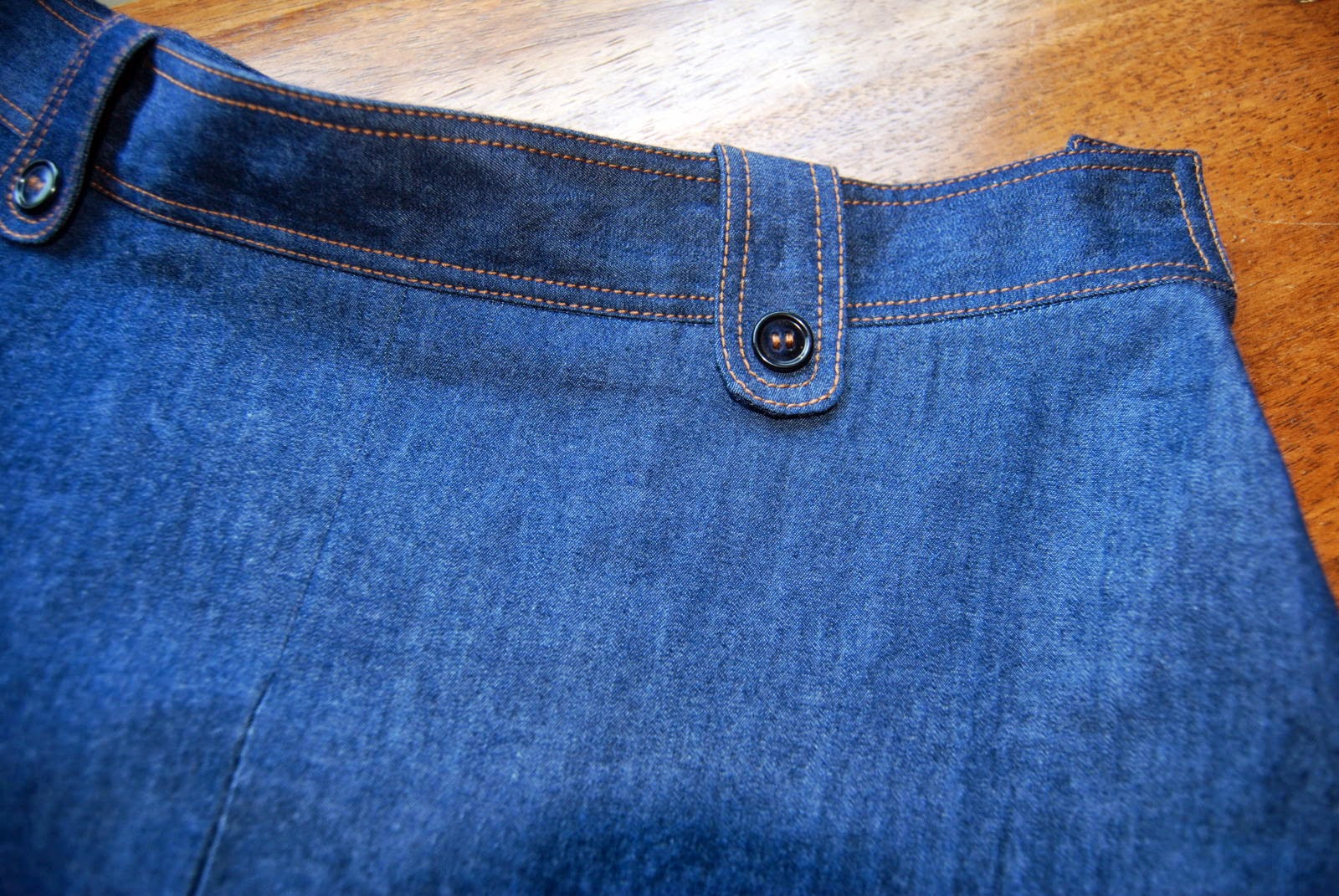
The waist band detail is nice. It's not too fussy, but adds some interest to an otherwise plain Jane garment. The light weight denim was easy to work with and gave me crisp pressing lines for the center box pleat.


Here's the modeled garment. Even with the belt, I'm please with the look.

Garment finish: A
Fit: A
Choice of Materials: A+

Friday, July 25, 2014

Simplicity 2758 - Waistband Details


 This is the only fussy part of constructing this skirt, the waistband detail. I basted in the waistband facing.


 It took a lot of trial and error to get the top stitching right. I think a good deal of error remained.

Some black horned buttons finished off the waistband detail.

Thursday, July 24, 2014

Simplicity 2758 - Preparing the Details

 Here's all the pattern pieces cut out and I'm ready to mark them. You can see that I've redrafted the skirt pieces. I have to grade up for a wider waist and I also accounted for a higher hip. The waistband has extra length, but the other detail pieces for the inverted pleat and the belt loops remain the same.


 I took the time to work out the top stitching detail for the skirt. I was right in doing so, as the tension between the heavy top thread and the normal bobbin need to be carefully balanced. I'll admit that there was much muttering under my breath and lot of scraps in the wastecan before I got it to look correct.
The belt loops were fussy little bits. The curve was tight and needed to be clipped and trimmed evenly. They are slightly off from one another, but I am not a factory robot either. The top stitching had to be done very slowly. I had to stop and turn for every stitch on the inner curve!

Thursday, July 17, 2014

Simplicity 2758 - Planning and Drafting


The next project is a denim skirt. I've chosen a Simplicity pattern, number 2758. It's from their "Threads - Step by Step" range. These patterns tend to be well drafted and this one has a blouse with C and D cup options. That's right up my street! I could use a nice blouse for next fall, but for now, back to the skirt.

The skirt is very simple. It's an A-line silhouette with a large inverted pleat at the center front seam. There is some waist line detail on this skirt. It has some optional belt loops which are really cute. I've decided to include those in my project since the skirt is smooth with no fullness at the waist seam. I've chosen a light weight cotton denim for this project. The first job is adjusting the pattern for my waist line without adding extra to the hip. After that, it should be a straight forward project.

Wednesday, July 16, 2014

Vogue 7375 - 1952 In Today's Wardrobe

After a couple of washings and wearings, my first 1952 Vogue 7375 skirt has settled down to be part of my modern wardrobe. The gathers at the waist have softened and flattened and I'm more pleased with the effect. I nearly always wear it with a simple tee shirt and a cotton cardigan sweater. Fundamentally, I'm still uncomfortable with the waist of this skirt as I couldn't make this garment again out of a crisper or heavier fabric. I'm going to think very carefully about how a full skirt can be made to fit my body type better than the dirndl silhouette.

Next project is a denim skirt. It's a more of work horse in my wardrobe than a pair of jeans and I need to replace it often. I've chosen a simple A-line skirt pattern and the denim came from my last fabric haul.

Tuesday, July 15, 2014

Vogue 7375 - 1952 Final Evaluation

Oh dear, life's major and minor events have taken me away from my sewing room and this blog for far too long. I have finished my first project from VoNBBS. This is my take on Vogue 7375 - The Full Gathered Skirt.
 Here's the finished skirt on my dressmaking form. I'm happy with the finish of the garment. There are no major mistakes, even after I had to adjust the waistline measurement and loose my couture buttonhole. The plaid matches very well. You can see the black stripe at the waist is about half waistband and half gathered skirt. The hem line is straight and ends with about 3/4 of a black stripe.

I am concerned with the gathered waist and my thickening middle. I've said this before on the blog,  I have three major fitting problems. They are a larger than average bust line, a thick waist and a short waist length. Only one I can do anything about physically, the thick waist is a constant battle that is proving more and more difficult as the years go on. The other flaws are just my body type. Normally, I wouldn't choose this type of pattern because it draws too much attention to my mid-section. Contruction grade: A-

And I was correct! Not the best look for me, but it's not a complete failure. (Yes, worse sewing disasters have been made in the recent past.) The light soft gingham saves the look by not be too puffy at the waist. I would wear this with an untucked blouse or sweater rather than the belt. Style and Wear Ability: C-

Here it is again with a black twinset sweater. I apologize for the photo. The quality is simply awful. It has a huge flash shadow which adds so much more width to the whole effect. The skirt style is much better with a sweater or over blouse, however the black twin set and pearls is a far too literal interpretation of the 1950's and the effect becomes costume. Style and Wear Ability: up one-half to a C.

I'm going to have to think seriously about the styles in VoNBBS and pick and choose very carefully.

Saturday, June 21, 2014

Vogue 7375 - 1952 Construction

The skirt is very straight forward to put together. All the seams are straight stitching. It will be the finishing details that make the garment. The back seam, which has the zipper closure at the top, I have pressed open and have finished the edges with a Hong Kong finish. This first photo is the bias strip applied to one side of the seam. 


 Here, I roll the bias around the edge of the seam allowance and finger press it open. I pin the bias in place and  I will stitch in the ditch to secure the bias to the back side of the seam allowance. Since it's bias cut no further finishing is needed and the gingham will not ravel.
 Next I basted the zipper in place, before machine stitching the zipper. I prefer to take this extra step. It allows me to make small adjustments and if I don't like the zipper placement. The hand basting is a flash to remove, not so when it is machine stitched. I also find that the pins just don't hold things securely enough.
 Hand basting helps me to achieve good results most of the time, especially when dealing with matching plaids. The other two skirt seams were done with quarter inch french seams. I don't have photos because I became so engrossed in my work that I forgot to take the pictures.
 I did make a bound button hole for this garment, butttttt.....I had to remove it because shortly after this garment was completed I went on a diet and succeeded. Two inches disappeared from my waistline and the fastest way to remove them from my skirt was to open the back waistband seam and adjust an inch on each side. Looking back on this, the bound button hole is a nice teaching point for VoNBBS, but I think the machine stitched buttonhole will hold up better particularly because waistbands can be a source of stretch and strain for many woman. (Note: Including me....especially including me.)Two lines of gathering stitches and many pins secured the waistband to the skirt body for basting.

For the hem. I used a satin ribbon hem tape and some careful hand stitches. My hem was slightly over three inches deep. I cut the skirt so that the hem line would fall on a black horizontal stripe and I rolled about a quarter of the stripe to the back in the hem. If I hemmed either on the exactly the line between the horizontal stripes or on a white stripe I felt any small lack of accuracy would be noticed. The black stripe seemed to minimize these errors.

Sunday, June 15, 2014

Vogue 7375 -1952 Pre-Construction Details.

 The original directions in VoNBBS say nothing of interfacing. The cotton gingham is very light weight and a bit limp. I feel some sort of support is needed in the waistband. I'm using cotton organza which is sewn in the old fashions way. I find I get less stretching and shifting by hand basting the interfacing to the fashion fabric.
 Here I've marked off the overlap at the center back for the waistband and pressed the facing edge up a 1/2 inch.
Here you can see I've marked the center front of the waist with some long basting. This will help me distribute the gathering evenly.
 Finally, I used a small piece of iron-on interfacing along the seam edge where the zipper will be sewn. The gives the zipper some support on the very light cotton. After each piece is prepared for construction, I pin them in place on my dress form right-side out. This keeps left and right and inside and outside in the correct order. I also don't loose things as I go about construction.

Old Cookbook Menus

These two days of menus come from a 1945 cookbook written by Vera Bradely. The book has an entire years worth of suggestions for three meals...