Sewing begins and ends with reflection. In a very basic way, you have defined your end by choosing to learn to sew. The next question should be do you want to descend into the home sewing hobby in controlled flight or uncontrolled chaos?
"Uncontrolled chaos sounds fun"....Oh, it can be fun and for some extremely rewarding. You may already be on the path to sewing chaos by being the person who received a sewing machine and not a mirror for Christmas. Congratulations! Have fun! But many experienced sewers will also hear from you in a month or two.
"Help! I've got this project and I can't finish it. Will you help me?" ...and in a crumpled paper bag you will have the remains of your first sewing project. It will be consist of $80, $10 or $400 worth of crushed rayon velvet, Goodwill purchased poly/cotton sheets from the 1970's, or uneven woolen tartan bought by your mother-in-law on her one and only vacation to Scotland. You will need to have the party dress, curtains, or suit finished in two hours, two days or two weeks. You will have cut the dress front with the velvet nap going up and the back with the nap going down. The curtains are in good shape except for the last panel which is seven inches too short and you are out of sheets. The suit is cut but the plaid is unmatched and you did make it through constructing the skirt but the waist is too tight. Can I alter the skirt to fit?
Believe me, I've seen it all. I'll make you a mug of tea and listen to your tale of woe. I'll let you tell me all about your aspirations and then I'll be harsher that you can ever imagine. I'll tell you in the kindest way possible. "The only place for the contents of that crushed paper bag is the garbage bin." I cannot help you. I will not help you and our friendship is probably doomed.
Nearly all first time sewers make these mistakes, they fail to match their level of ability to project difficulty and fabric appropriateness. It happens. It happens most frequently to new sewers, but even experienced dressmakers have "wadders." Have two or three disasters in a row and real self doubt sets in. But have something come out as a smashing success, that feeling will be there with you every time you wear the garment.
Are you ready for flight school? It's assignment time.
Assignment #1:
Have you started your "Idea Journal"? Pull up a chair, a mug of tea and some day dreaming time and take a look at what you've collected. Do you dream of high end fashion? Do you want to push the envelope of conventional clothing definitions? Do you prefer home decor? Crafty items? Knitwear? Do you dream of silk cocktail dresses or tweed suits? Do you want to recreate vintage items? Do you want clothes that fit better? What are your interests? Try and identify some trends. Write six to eight sentences about what you dream about doing.
My sentences would be.
I want to sew clothes that fit me.
I want to have really nice clothing, that lasts for years.
I like classic lines, and traditional fabrics.
I am drawn to vintage clothing especially items from the 1930's to the mid 1950's.
I want to include vintage ideas into my wardrobe without becoming costume or campy.
I want to save a ton of money on home decor because I have designer tastes and a thrift store budget.
I want to be able to sew some of my clothes but also be able to buy quality RTW at all price points.
Assignment #2:
Take an honest look at your lifestyle. What kind of activities, jobs, or roles to you have in your life? Define each one. You may be a parent or care giver. You may have a job that has specific dress codes. Your hobbies might have clothing requirements. A parent of two year old twins might wish for clothes impermeable to grape jelly and craft paint. An office worker dresses one way and police officer another. A gardener wears one thing and museum docent another.
Make a list of as many of your roles as you can. Try and quantify how large a part of your time you spend in each roles. It is from this list that you will begin to guide your sewing and wardrobe. From each of these activities or clothing needs you can direct you project choices.
Here's the beginning and end of my list. I want you to write your own.
My largest role is housekeeper. I need clothing that is tough and comfortable and classic and washable.
My smallest role is bar hopping party girl. I need only one versatile outfit for this one that is worn once per year or less.
From this list, the vast majority of my clothes consists of sportswear separates and no sequins.
You should use these two lists along with your own geography and climate to help you choose your wardrobe pieces and sewing projects. I should be making easy wear tops to go with jeans, shirt dresses, and active wear and outerwear for all kinds of variable weather. I should not be making party dresses, office wear, Hawaiian shirts or Edwardian reproductions no matter how much I like the patterns and fabric. Even if you decide sewing is not for you, knowing how much of what kind of clothing belongs in your wardrobe is cost saving. (I don't always follow this advice 100% of the time, but 9 times out of 10 it works.)
Sunday, December 28, 2014
Wednesday, December 17, 2014
Soooo....You want to learn how to sew.....
Warning: I am very opinionated about the topic of learning how to sew and I can be quite abrasive with my remarks. If this sort of thing offends you, please understand I want to save you from catching the disease of sewing. It's not a deadly disease, but it can not be cured. Sewing can lead to lifelong consequences, such as investments in expensive machines, cutting and tossing gorgeous fabric, hoarding supplies, needing an extra room in your home and having a ghastly aversion to RTW fashion. But gosh darn it, sewing can be so much fun!
I've decided to write a series of posts about learning to sew, because I got one of the Christmas questions nearly every experienced sewer dreads to hear.
"I want to learn how to sew my own clothes and my husband/partner/mom/generous patron is going to buy me a sewing machine for Christmas. Can you suggest which machine they should buy?"
This!...Two weeks before Christmas!
My universal answer is... "Put the credit card down and slowly back away from the machine. You will either over or under spend and the recipient will never get the machine they need or want."
My gift suggestions for this situation are as follows:
- Choose something very nice from the jewelers.
- Pay for some lessons from a locally owned sewing store where basic machines are provided.
- If you completely insist on starting your collection of sewing tools, begin by purchasing a full length mirror.
A FULL LENGTH MIRROR! You've got to be crazy to suggest that for a gift at the holidays. After eating all that Christmas turkey and drinking all that booze, no one will appreciate a mirror. It's like giving a vacuum cleaner to your spouse as an anniversary gift.
Yes, a full length mirror is your very first investment in learning to sew. Buy the best one you can afford and mount it somewhere that you have enough space to "model" for yourself and where there is good lighting. The back of the door in a poorly lit cramped bathroom is not a good place, neither is the corner of a damp and dingy basement or attic where you someday envision a "professional" sewing studio. It won't happen, at least not yet. Hang that mirror somewhere near where you dress every morning and begin to use it. Oh, and by the way... Are you thinking of using a large bathroom vanity mirror or mantle mirror in the living room as a substitute? No! Just don't even think about it. Buy a proper full length mirror. Trust me on this one. Even if you decide that sewing is not for you, your mirror will still be a good investment.
If you can not bring yourself to make the investment in a proper mirror, then sewing clothes for yourself may not be your thing. Don't worry, it's not a deal breaker at this point, there is quilting, home decor and crafting all of which use sewing skills. There is also knitting, crocheting and all sorts of other handcrafts that can satisfy one's need for creativity. But please take note, this should be a warning sign. Persevere through the next couple of lessons before making your final decision. I will be clearly giving you exit points during these beginning lessons and there is no shame in waving goodbye. The shame comes from buying and then storing an unused sewing machine in the attic, not from saying, "Thanks, but no thanks."
Okay...got it? Now have a great time with Christmas and don't worry about sewing until the New Year. I'll post the first sewing lessons during the holidays and the assignments can be done in January.
In the meantime, to satisfy your sewing bug, here are some inexpensive suggestions
1.) Go to the local library and check out some sewing books. Read them for fun. Don't worry about not understanding everything or getting lost with the directions. Look at the pictures and take note of what really interests you.
2.) Use the Internet to read other sewing blogs.
3.) Look at a site like Amazon and use the "See Inside" feature to look at currently popular sewing books. BUY NOTHING! Don't even put them on a "Wish List."
4.) Visit your local book shop to look at sewing books. Are you tempted to buy? DON'T! Reward yourself with a double latte at the coffee shop and return home to reflect on what appeals to you.
5.) If you are very lucky to have these resources, visit your local sewing store or stores. Browse. Get a feel for their inventory and their level of service. Leave the credit card at home!
6.) Visit your local "Big Box" hobby/sewing center. Browse. Get a feel for their inventory and their level of service. Leave the credit card at home and don't sign up for their mailing list, at least not yet.
If you insist on completing an assignment, start a "sewing idea journal". Use a found notebook, a old loose leaf binder, a paper folder or a virtual bulletin board. It is not necessary to buy anything to start this assignment. Start collecting images of things that appeal to you as a sewer. Don't limit yourself to just things other people have sewn. Include fashion photos, home decor and soft furnishings photos, quilts and crafts....anything and everything that appeals to you. Only by creating a collection will you begin to see trends for yourself. This will become that basis for making some decisions about what kind of sewing you'd really like to learn after you've mastered the basics.
Cost of this lesson: Your full length mirror, if it's not a gift, and the optional coffee latte at the bookstore. All other gift suggestions are at the reader's discretion.
Wednesday, December 3, 2014
Oh dear, oh dear, oh dear.....
I've fallen into a giant sewing hole and I'm battling my way out. Let's just say that drafting this pattern has become a nightmare. I should have made at least 2 more muslins, but nooooooo....I thought....3 is enough....I can do this. HA! The karma in my sewing room has risen up from the threads on the floor and linted up my brain and taken more than a few pegs out of my sewing hubris.
"Needles" to say there have been tears and frustrations. I am battling on and I promise there will be a garment out of this yet. In the meantime, I'm keeping my eyes firmly on the pattern drawing and out of the overflowing waste basket in the corner of the sewing room.
Tuesday, November 18, 2014
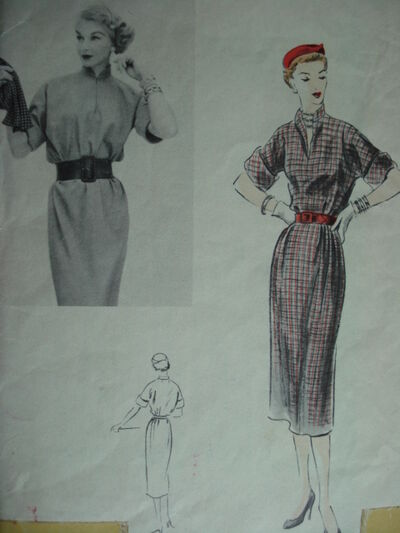
Vogue 7321 - 1952 The Slim Chemise Dress
I closed my eyes and jumped of the high diving board into pattern drafting with this project and I definitely feel like I'm drowning. Clearly, this is a detailed oriented skill that needs to be developed over time under the tutelage of an experienced drafter. After a lot of time, many stops and starts, and several rolls of paper, I got a bodice front and back.
From there, it was another roll or two of paper and I think I have a first guess at my recreation of Vogue's 7321 Slim Chemise Dress from Vogue's New Book for Better Sewing.
Sooooo....I cut my first muslin. Not bad....but some issues exist. The collar is too high and the sleeves are not long enough to accommodate the cuffs turning back and finally the bust dart is not quite right.
Back to the drawing board!
From there, it was another roll or two of paper and I think I have a first guess at my recreation of Vogue's 7321 Slim Chemise Dress from Vogue's New Book for Better Sewing.
Sooooo....I cut my first muslin. Not bad....but some issues exist. The collar is too high and the sleeves are not long enough to accommodate the cuffs turning back and finally the bust dart is not quite right.
Back to the drawing board!
Tuesday, November 4, 2014
A Revisit to the Plaid Circle Skirt
After wearing this skirt a couple of times, I realized the plain simple narrow waistline was just too large...but what to do about a "precut" circle? You just can't magically add fabric to make the waistline narrower. Gathering the excess isn't the answer either.
Here's my solution: It's a wide, fitted waist with a button detail.
Thursday, October 30, 2014
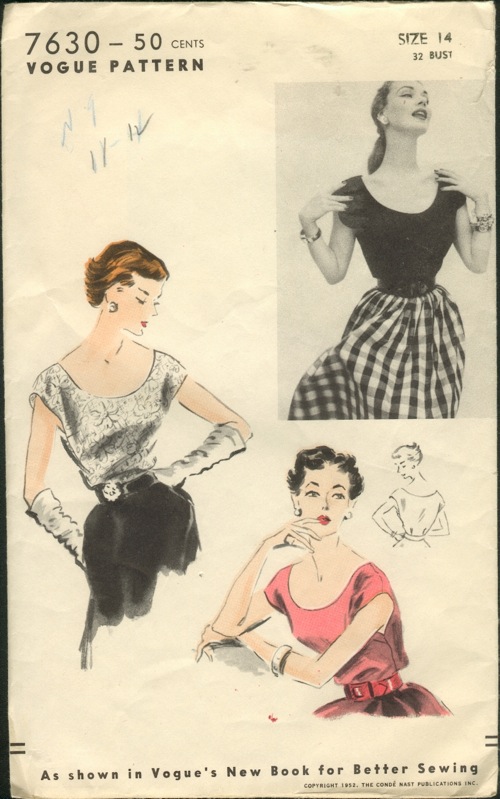
Vogue 7630-1952 - The Portrait Neckline Blouse - Finished
Pattern trial number two gave me this. Four pieces, that except for the full bust, looked pretty similar to the illustrations in VoNBBS. I specifically choose to create "net patterns", that is, patterns without seam allowances. I found this gives me an easier time doing a couple of things, fitting on my dress form and "walking" the seams.
Then, I got busy with the project and didn't pick up my camera until nearly the end....hemming the sleeve.
Here's the finished blouse with the slim skirt and my farmer's tan.
Here it is again worn as an over-blouse with the gingham skirt. The black color and poor lighting of late autumn in northern Europe sucks all the detail out of the photo.
Garment Finish: Good to excellent overall. This is a linen blouse, so I chose to over lock the seam edges to prevent raveling. The zipper is a lapped application in the side seam. A-
Fit: Actually, I'm surprised. My first attempt at pattern drafting isn't bad. The fit is good, maybe a little large, but I've certainly had far worse at the hands of other pattern makers. For a first project: A-
Choice of Materials: It's linen. It wrinkles! It's clearly a summer blouse. I would choose cotton next time for ease of washing, or silk for something dressy. B+
Style and Wearability: This 1952 style still works today. I could make this out of a number of different fabric or colors. As you can see I have paired it with the more formal slim skirt and the casual gingham skirt and I've got two distinct looks. I could wear this with jeans and a blazer also. A+
Overall: A-
Not bad for jumping in at the deep end of pattern drafting.
Tuesday, October 28, 2014
Vogue 7630 - 1952 The Portrait Neckline Blouse
According to VoNBBS, the portrait-neckline blouse is "easy-to-make" and "has a way of making you look your prettiest and most feminine." Well, bottle that up and sell it! I'm buying. It's a blouse, a simple one at that. There are no sleeves, cuffs, collars or buttons. What's not to like?
Plenty, when you don't have a commercial pattern at you finger tips. This week, I cracked open the dreaded "Pattern-Making for Fashion Design" by Helen Joseph Armstrong. I felt as if I'd gone back to school...the tables, the diagrams....the exercises...the revelations!
The second chapter is an exhaustive discussion of fashion industry standards, how they are categorized and why they may or may not be used. Next came a five or six page set of exhaustive diagrams on how to take all 38 plus measurements from a standard fashion industry dress form. Many of these, such as bust, waist and center front length are very familiar, but others such as abdominal arc, bust span and strap length were completely new to me.
As I don't have a industry standard dress form hanging around the work room, I took my own measurements and filled out a two page form from the book's appendix. I had it on paper, me in Oct 2014, every roll, ripple and bulge. Then, I turned the page and found a table entitled "Standard Measurement Chart". Across the top of the table ran the headings grade and size, from size 6 to 18 and down the size ran a list of all the measurements I had just painstakingly recorded for myself. For kicks, or a malicious sense of self-inflicted pain, I circled my real measurements as they appeared on the table.
The results were both humiliating and revealing at the same time. All my "vertical" measurements fell into the 6-8 size and all my horizontal measurements fell into the 16-18 size. This explains so many of my fitting problems with commercial patterns and why I cannot find retail clothing that fits. It also scares the heck out of me for pattern drafting.
I won't bore you with all the gritty details of Chapter 3 - Drafting the Basic Pattern Set, but I will say that my 6-8 by 16-18 figure created drafted drawings that in no way looked like the illustrations in the textbook. The result was a lot of self-doubt, many repeated exercises and several rolls of pattern paper and a couple yards of muslin on the work room floor. In the end, I did get a skirt and bodice basic block pattern completed and fitted. I have not attempted a sleeve block. That will come later, perhaps in the spring.
Using the block as a guide and skipping through dart and neckline manipulations, using only those exercises that applied to Vogue 7630 - 1952, I came up with this trial pattern.
...and this first muslin.
Hmmm...trial two....coming up.
Friday, October 17, 2014
Simplicity 1590 - Forties Blouse
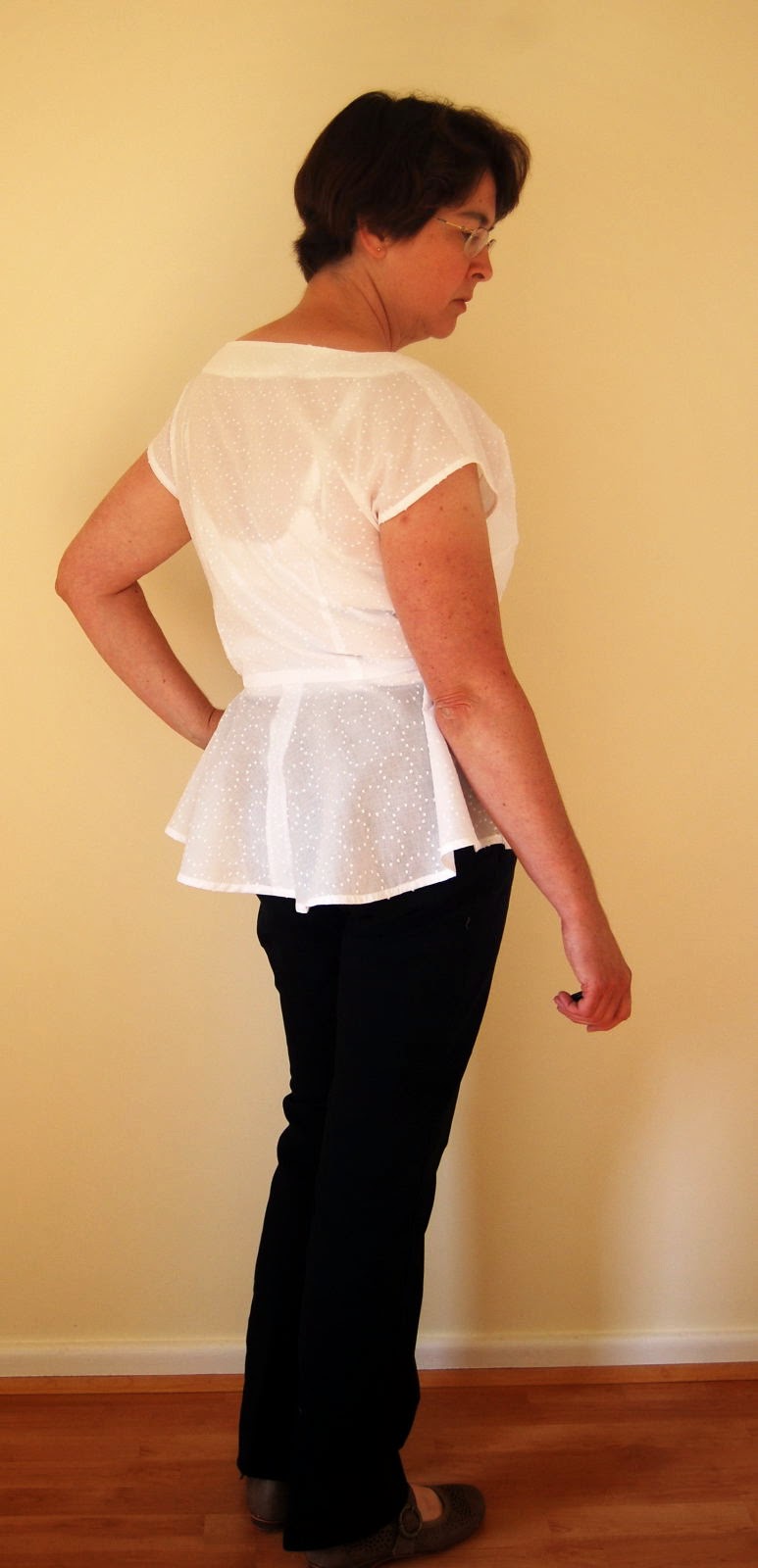
Well, it's finished. I'm not sure I like it. I think the choice of fabric is all wrong.
The cotton is just too transparent. I'm also wearing it in October; this is summer blouse that needs a light colored cotton skirt underneath it.
The garment finish is good. I didn't spend a great deal of time on special seam finishes with this garment. The quality of the fabric just didn't warrant the effort. This project is much more about style and pattern testing than french seams and organza interlining. Garment Finish: B-
Fit: The fit is good. The back and waist are smooth and there is no gaping in the front. The full bust adjustment is a success. Fit: A
Choice of Materials: C- It's not a complete failure, but nearly so. The cotton is shear but very inexpensive. It won't wear well in the end and therefore didn't require the extra time and expense of lining the blouse. Given that, I still wouldn't want to spend a great deal time or money for a first trial of a new pattern. I think this garment would look better in a silk, charmeuse, or nice dress weight cotton. I will be worth trying it again before deciding if the pattern is a keeper.
Style and Wearability: B The blouse is very much a success in someways and a dismal failure in others. As this project is a precursor to the completely self-drafted copy of the VoNBBS's portrait neckline blouse, it is weighted more for a success. The neckline is attractive and flattering. The cap sleeves give just that little bit of cover for the shoulders. Both these features are important for VoNBBS's Vogue 7630. I don't care for the peplum. It emphasizes a part of my body I wish to ignore and I cannot tuck this blouse into a skirt or pant. This limits it's wearablity.
Project Overall: B-
Now, I'm looking forward to my first redraft of an old pattern from VoNBBS, Vogue 7630, the portrait neckline blouse. I think I can do this! Think positively! I can do this.....yes, maybe, welll...let's see.
"Patternmaking for Fashion Design" by Helen Joseph Armstrong here I come.
Wednesday, October 15, 2014
Simplicity 1590 - Construction
I always, always, always baste and check dart placement, especially after a full-bust adjustment. Sometimes the project is a wadder right then and there. It saves disappointment in the end with an ill-fitting finished garment. As I cannot fit the garment and photo the garment at the same time on me, you get a photo of "Judy" wearing the blouse. Judy is just about my size, but I find I get a better fit if I slip the garment on for final okay. So...the dart is in the correct position and stops before the bust point and I've got no front blouse gapping.. I can proceed.
Here's the front before buttons and button holes. I'm not thrilled with the transparency of the fabric. I guess this one will fall under the category of "must wear a camisole."
Tuesday, October 14, 2014
... Because I'm procrastinating self-evaluation.
A vintage portrait neckline blouse is up next. It's not Vogue. It's not VoNBBS. It's not the early 1950's....but has the correct neckline and the correct sleeves. The waistline darts can be converted later into pleats. The biggest style differences between the VoNBBS (Vogue 7630 -1952) and Simplicity 1590 is the addition of the peplum and the front button closure. Neither of these are deal breakers for this project.
I'm going to make View A and redraft the front for a FBA to a D-cup. I have a piece of lightweight summer cotton with a circular chenille design for the project and some simple plain white buttons.
Below is a photo just before cutting. The pieces redrafted are the front bodice for a FBA and the front facing has some length added to it because of the FBA. Otherwise, I'm going about this "as directed" by the pattern instructions.
I'm going to make View A and redraft the front for a FBA to a D-cup. I have a piece of lightweight summer cotton with a circular chenille design for the project and some simple plain white buttons.
Below is a photo just before cutting. The pieces redrafted are the front bodice for a FBA and the front facing has some length added to it because of the FBA. Otherwise, I'm going about this "as directed" by the pattern instructions.
Wednesday, October 8, 2014
The Next VoNBBS Project - The Chemise Dress or the Portrait Neckline Blouse?
The two easiest patterns for beginning pattern drafting will be the Chemise Dress and the Portrait Neckline Blouse.
I'm very tempted to start here with Vogue 7231 because is looks so modern. We are still wearing this shape today. Here's a modern pattern for essentially the same look. Although, please Vogue be careful of your fabric choice and construction before using the sample as the pattern photo.
However, after looking at the general shape of the pattern pieces from the original pattern, I'm doubting myself.
For heavens sake, look at them. There's not much there. There is nothing to hang a T-square or triangle on. There are few discernible points to begin with ...center back and front and a slight indication of a front bust dart, but other than that the pattern lacks definition. I think this could be very easy to get very wrong very quickly, especially since the fabric in my stash is a plaid. I want to show off the bias cuffs but the rest of the dress had better match. Being off grain will not be acceptable on this project. I think a solid fabric might hide these fundamental pattern errors and I wish to avoid them at all cost.
....Actually, anything to delay cracking open that textbook and evaluating myself next to fashion industry standards.
Subscribe to:
Comments (Atom)
Old Cookbook Menus
These two days of menus come from a 1945 cookbook written by Vera Bradely. The book has an entire years worth of suggestions for three meals...
-
Now, it is nearly March. The winter was a tough one and it is not over yet. Weather and health were the two main foci. The snow and ice have...
-
Yesterday was successful, but not the the ways I expected. The external chores, those pertaining to shopping, banking, and the pharmacy wen...